
In a quiet classroom in Dubai, a child with autism sits across from a simple robot. The machine's face displays a gentle smile — uncomplicated, easy to read, and free from the bewildering complexity of human expressions. Through carefully personalized stories, the robot teaches basic social skills, from how to start a conversation to how to respond to a greeting.
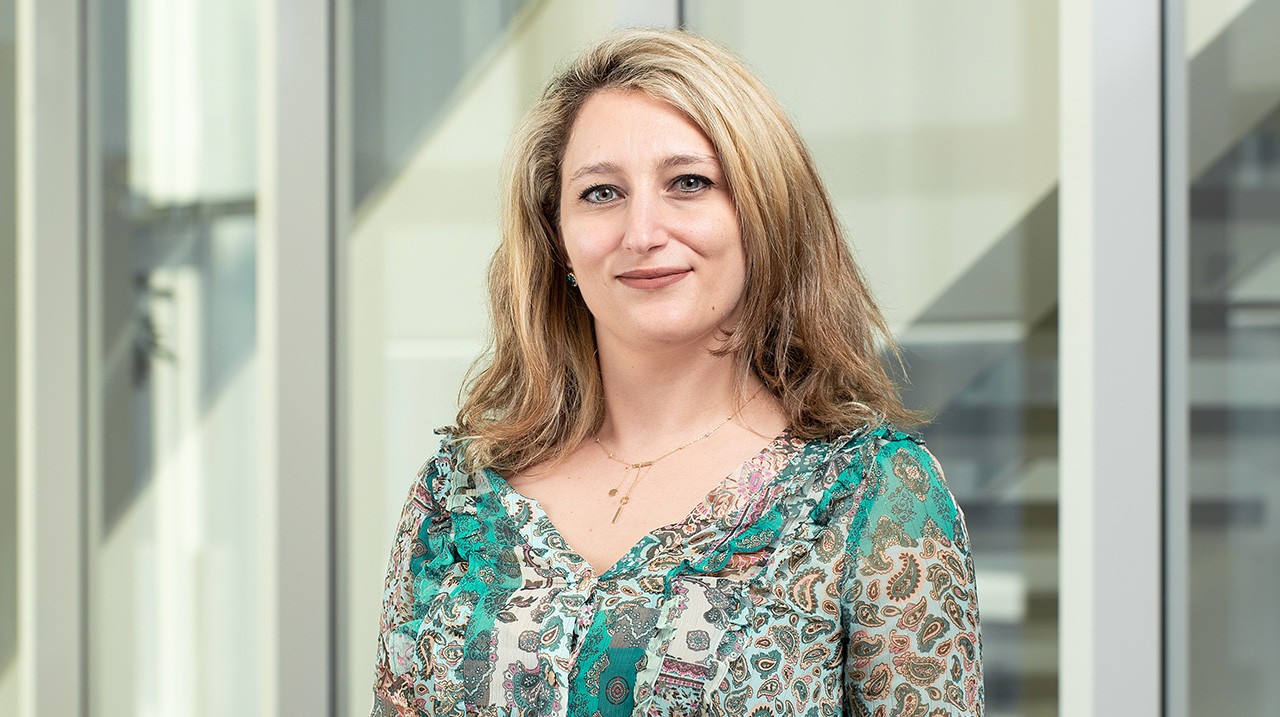
This vision of technology serving the neurodivergent community is the driving force behind the work of Hanan Salam, Assistant Professor of Computer Science at NYU Abu Dhabi and director of the Social Machines and RoboTics Lab.
“I don’t believe in developing for the sake of developing,” Salam says. “I have a purpose: to use whatever I’m doing now to advance humanity and help people.”
The human touch
It's an ethos that defines her career, one that began not with algorithms and code, but with a fascination for human behavior. Growing up in Lebanon as the only daughter among four brothers, Salam was drawn to psychology, sociology, and literature — subjects exploring what makes us human. Yet she chose engineering , partly for practical reasons, and partly to defy expectations.
“Back then, women were not encouraged to do engineering,” she recalls. “I wanted to have this competition, this challenge, and choose something that was expected more from my brothers,” Salam explains.
She studied computer science at the Lebanese University, followed by a master's degree in Control, Robotics, Signal, and Image Processing at École Centrale de Nantes in France. Salam’s PhD at CentraleSupélec focused on modeling human emotions and facial features — work that wasn't yet called AI but used its techniques. “It was related to human behavior,” she explains. “That's what I really wanted to study.”
The breakthrough came during her postdoctoral research when she began working in human-robot interaction. Suddenly, the recognition systems she'd developed for emotions, gaze, and facial expressions weren't just analyzing human behavior— they were enabling machines to respond to it.
“The robot needs to understand the engagement level of the human when they are interacting with it,” she says. “It needs to understand their mental state, their emotion, and their personality.”
Technology with purpose
Today, that work has crystallized into socially impactful projects. In collaboration with the Rashid Centre for People of Determination in Dubai, one application delivers personalized social stories to children with autism. These stories, which teach interactions like initiating conversations, are tailored to each child's developmental level and include visuals resembling each child. Practitioners use a chatbot interface to request recommendations while AI analyzes behaviors. “Children with autism often prefer to interact with machines or robots,” Salam explains. “Robots don't have complex social expressions. There's not a lot for an autistic individual to decode.”
Another project, called GROW, targets the mental well-being of university students. The AI-powered interface helps students at NYUAD identify goals, break them into tasks, and schedule them, while monitoring stress levels and emotional states through conversation. “Students can become very overwhelmed,” Salam observes. “They don't always know how to set up their priorities. This helps them focus on their goals and achieve them.”
The approach is deliberately cautious. Amid growing concerns about AI replacing human therapists, Salam maintains her work is complementary, not substitutional. “This is not to replace the therapist, but to direct the person to a therapist if needed,” she emphasizes. Privacy is paramount — data isn't retained without permission, users remain anonymous, and nothing is used to retrain models. If someone mentions depression, the system recommends professional help. “We always co-design with medical practitioners,” she adds, describing extensive collaboration with mental health professionals.
Her machines recognize human emotion through what she calls “multimodal recognition framework” — analyzing video, audio, and text simultaneously. They detect nods, smiles, hand movements, speech patterns, and gaze direction. “Low level can be nodding,” she explains. “High level can be nodding, smiling, and a fixed gaze, which shows engagement.”
Salam’s personal values still drive how she works professionally. Salam co-founded Women in AI in 2016, an international nonprofit working to close the gender gap in artificial intelligence. She describes herself as extroverted, empathic, “a people person” — traits that fuel her commitment to ethical technology.
“I'm an advocate for using technology for the good of the human, not for just having more money or becoming a millionaire,” she says. “It's about augmenting our capacities, our intelligence, so we can do better.”
Her next focus is personalized education. As co-director of NYUAD's new Center for Interdisciplinary Data Science and AI, she's developing LLM-based tutors — again, not to replace professors, but to provide students with help outside the classroom.
With AI advancing rapidly and Abu Dhabi’s government placing it at the center of its strategic agenda, Salam believes widespread robot integration could arrive within a decade. Her guiding principle is clear: technology should serve humanity, not the other way around, enhancing human connection where it matters most.