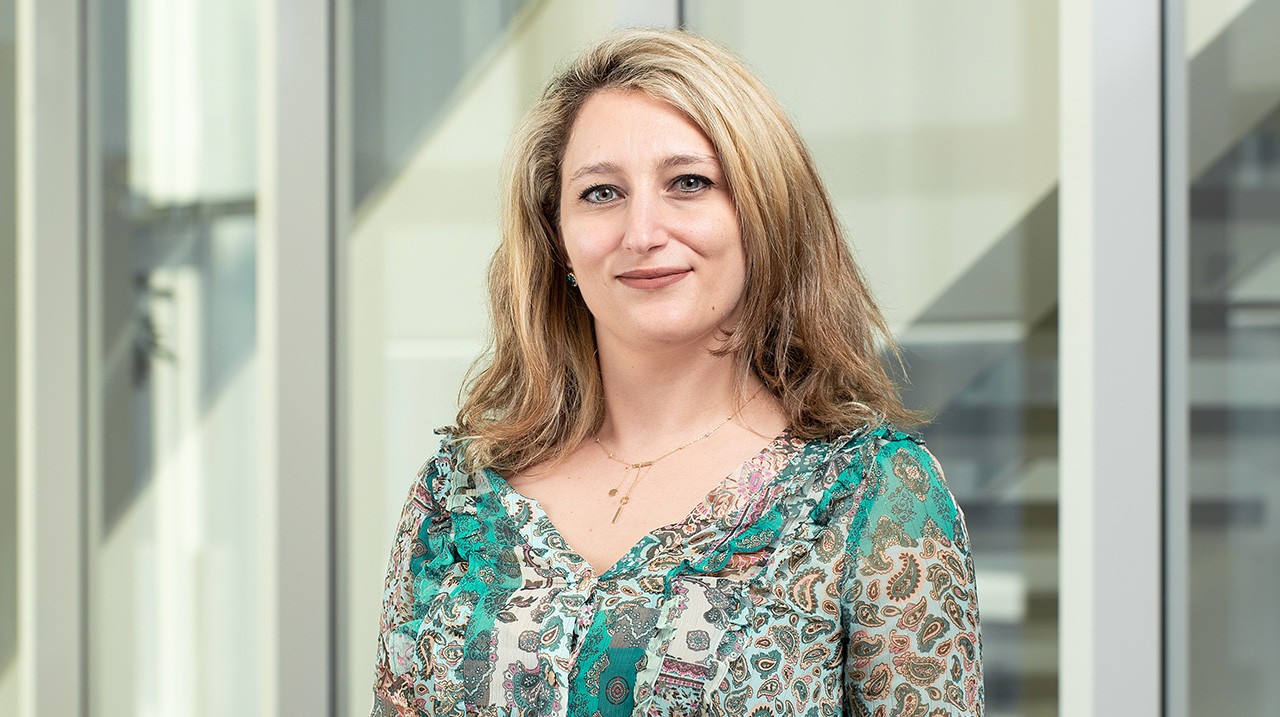
When a large language model doesn't know an answer, it often gets inventive. The solution, according to Djellel Difallah, isn't to build smarter AI. It's to give it access to better information.
Difallah, Assistant Professor of Computer Science at NYU Abu Dhabi, is developing knowledge graphs: vast networks of verified, interconnected facts that allow AI to reason rather than guess. Instead of generating plausible-sounding text based on patterns, AI systems could query real data and explain precisely how they arrived at their conclusions.
“Everything is around AI now,” Difallah says. “From jobs and education to journalism, the quality of what AI produces is only as good as the knowledge it draws from. That's what we need to get right.”
Human meets machine
Difallah's path to this research began in Algiers, where he grew up in the 1990s, when computers were rare in most households.
“I was a bit unsure about the future,” he recalls. After a year exploring different subjects, he settled on informatics amid the internet boom of 2000. “I was new to computers, but everybody was excited. There was a lot of mathematics initially, at least something I could understand. And then programming proved to be intellectually stimulating.”
After earning his engineering degree and working as a software developer for an internet provider and an oil and gas company, Difallah realized corporate life wasn't for him. Growing up with limited prospects for studying abroad, he applied for scholarships and won a Fulbright to study at the University of Louisiana, where he focused on databases.
A PhD position in Switzerland followed, where at the University of Fribourg he discovered a technique that would shape his career: combining human input with computer systems through crowdsourcing. Using platforms like Amazon Mechanical Turk, where thousands of people perform small tasks for payment, Difallah studied how to integrate unpredictable human contributions into the deterministic world of algorithms.
“Everything is largely deterministic when it comes to algorithms,” he explains. “Crowdsourcing, by contrast, introduces a human-in-the-loop component that is inherently probabilistic and noisy.”
Networks of information
After completing his PhD in 2015, Difallah spent two years as a Data Science Fellow at NYU's Center for Data Science in New York, then worked for the Wikimedia Foundation, the organization behind Wikipedia. This experience proved crucial. Wikipedia, he observes, is essentially a massive crowdsourcing project: an encyclopedia built by tens of thousands of volunteers worldwide. But its sister project, Wikidata, offered something more structured: a knowledge graph where entities and their relationships form an interconnected web of information.
“A knowledge graph is basically a network where each node is a real-world entity,” Difallah explains. “Between entities, there could be relationship links, whether a friend, co-author, or colleague. This creates a network of information.”
The power of knowledge graphs lies in their ability to represent knowledge in a flexible, evolving structure, making information both expressive and easily navigable. A system connected to a knowledge graph can integrate data from multiple sources, such as US Census and economic indicators from the World Bank, to consolidate information that is verified and up to date. More importantly, it can make logical inferences by navigating between connected entities and facts, much like humans do when reasoning through complex questions.
Difallah's vision extends to creating comprehensive networks of information. He imagines knowledge graphs encompassing everything from government institutions and road intersections to energy grids, news, and social networks, all interconnected in layers that feed into one other. In practical terms, this could mean AI systems that automatically find and integrate the most current data without users having to manually specify sources.
Since joining NYUAD in 2020, where he is an assistant professor and program head of computer science, Difallah has focused on discovering missing information within existing knowledge graphs. His systems use machine learning and crowdsourcing to infer complex relationships that aren't explicitly recorded. He also applies this work to real world problems, including modeling links between immigration patterns and economic shifts, as well as traffic prediction.

The work also addresses a crucial challenge: understanding why AI makes particular decisions. Unlike older black box models, systems built on knowledge graphs can trace the logical steps that led to an answer, allowing users to spot and correct errors.
“Explainability means understanding the reasoning behind a model,” Difallah says. “AI can support decisions, but it cannot yet replace human judgment.”
In the meantime, his current work on knowledge graphs offer something more immediate: a framework to make AI systems not just more powerful, but more reliable and transparent.