
When you unlock your phone, follow a map, or rely on a smart device to make a decision, there is an invisible layer of mathematics guiding every step.
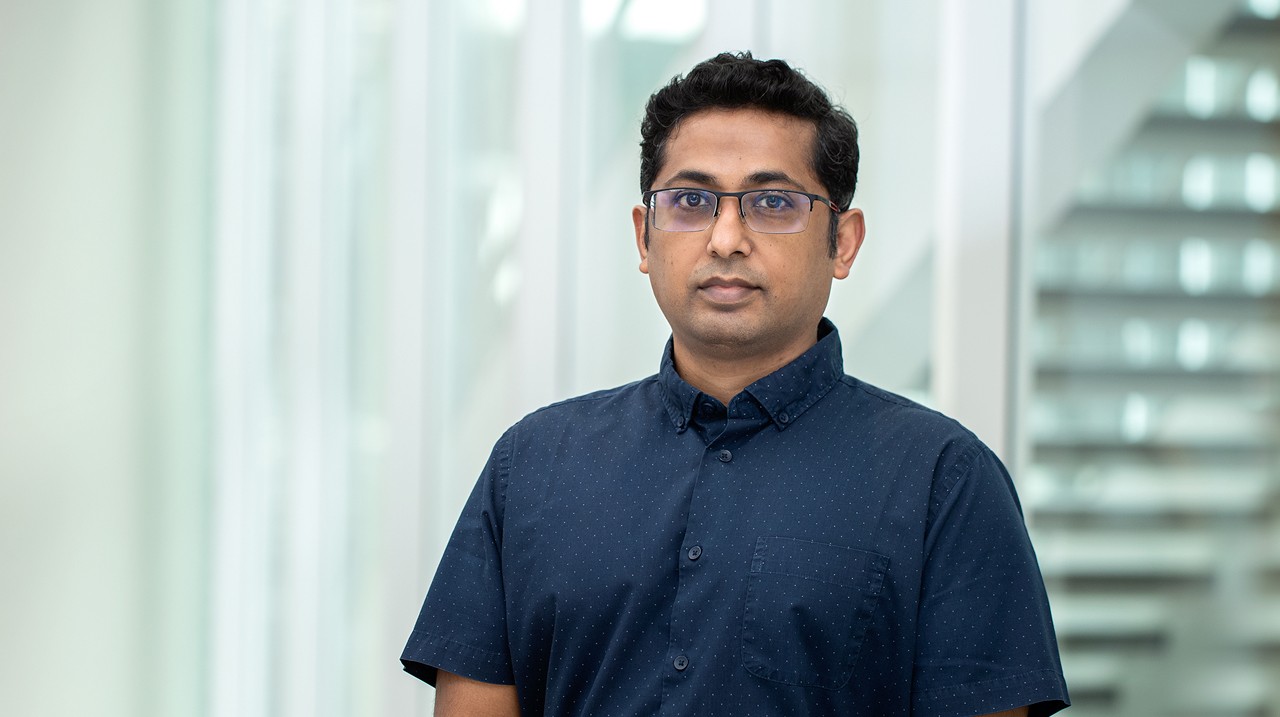
That hidden machinery is where Associate Professor of Computer Science Saurabh Ray does his most important work. “Most people never see the theory behind the tools they use,” he says. “But without that groundwork, nothing works as it should.”
Ray, from Odisha, India, joined NYU Abu Dhabi in 2014 after studying computer science at IIT Guwahati and earning both his MCS and PhD in Computer Science at Universität des Saarlandes in Germany. Today, he specializes in computational geometry and algorithm design — fields that may sound abstract but underpin some of the most practical technologies in modern life.
His research looks at how to break down everyday questions into precise, efficient instructions that a computer can follow. “If you model a real situation correctly,” he explains, “a good algorithm can solve a huge part of the problem for you.”
From cell towers to camera networks
Much of that work begins with geometry, which shapes more of daily life than most people realize.
Ray gives a simple example. “Imagine every house in a city as a point on a map,” he says. “If you want to place cell-phone towers so everyone gets coverage, you need to understand the geometry of those points.”
The same reasoning underpins tasks such as positioning Wi-Fi routers in a crowded building, placing security cameras so every corner of a gallery is visible, or modeling how water moves across mountain terrain. “The applications differ,” he says, “but the mathematical pieces repeat in surprising ways.”
Although Ray focuses on theory rather than hands-on deployment, the algorithms he studies often sit at the start of long pipelines that eventually shape real systems. “My role is to create the building blocks,” he says. “Other people adapt them to the application, but the core ideas are the same.”
His teaching at NYUAD has expanded that perspective. The university’s broad curriculum drew him into areas he had not planned to explore, including machine learning and computer graphics.
“Teaching those courses pushed me to understand problems as they appear in practice,” he says. “You see where theoretical guarantees fall short and where you need something more flexible.”
That shift led him into one of his main research directions today: beyond worst-case analysis. Traditional algorithm design focuses on the toughest possible scenarios — the input that makes everything slow. But, as Ray points out, real life is rarely adversarial.
“Most problems people actually face aren’t the difficult edge cases,” he says. “So the question becomes: how do we design algorithms that perform far better in the typical situations we care about?”
The UAE provides fertile ground for that thinking. Rapid urban development, large-scale infrastructure, and ambitious digital projects all rely on efficient models and decision-making tools.
Understanding how real data is distributed — how homes cluster in Abu Dhabi, how terrain shapes planning decisions, or how camera networks cover public buildings — makes it possible to tailor algorithms to local needs. “When you focus on the actual distributions you see in a region,” Ray says, “you can design tools that are faster, simpler, and more useful.
Quantum learning and the next wave of computing
Another thread of his work looks toward a different technological horizon: quantum computing. Ray studies quantum learning theory, which asks how quantum systems can learn from data and how many measurements are needed to make reliable predictions.
“In some fields, especially in chemistry or materials science, you can’t run endless experiments,” he explains. “So the question becomes: what is the minimum amount of information needed to understand what’s going on?” The impact is long-term, but the foundations built today could eventually reshape how scientists model complex processes.
After more than a decade at NYUAD, Ray says the intellectual atmosphere and student body continue to shape his work. He remembers the first course he taught — a small group of students from nine different countries.
“They came in with such different perspectives,” he says. “Interacting with them broadened my own thinking and pushed me to see problems from angles I hadn’t considered before.”
That has remained true as the university and city have grown around him. “The environment here pushes you to keep learning,” he adds. “You’re constantly exposed to new ideas.”
The result is a portfolio of research rooted in theory but connected to the region’s ambitions — from smarter urban systems to future advances in computing.
“My work is about building tools,” Ray says. “Some are useful now. Others may be useful ten years from now. But when the moment comes, the ideas need to be ready.”