
Brain Imaging
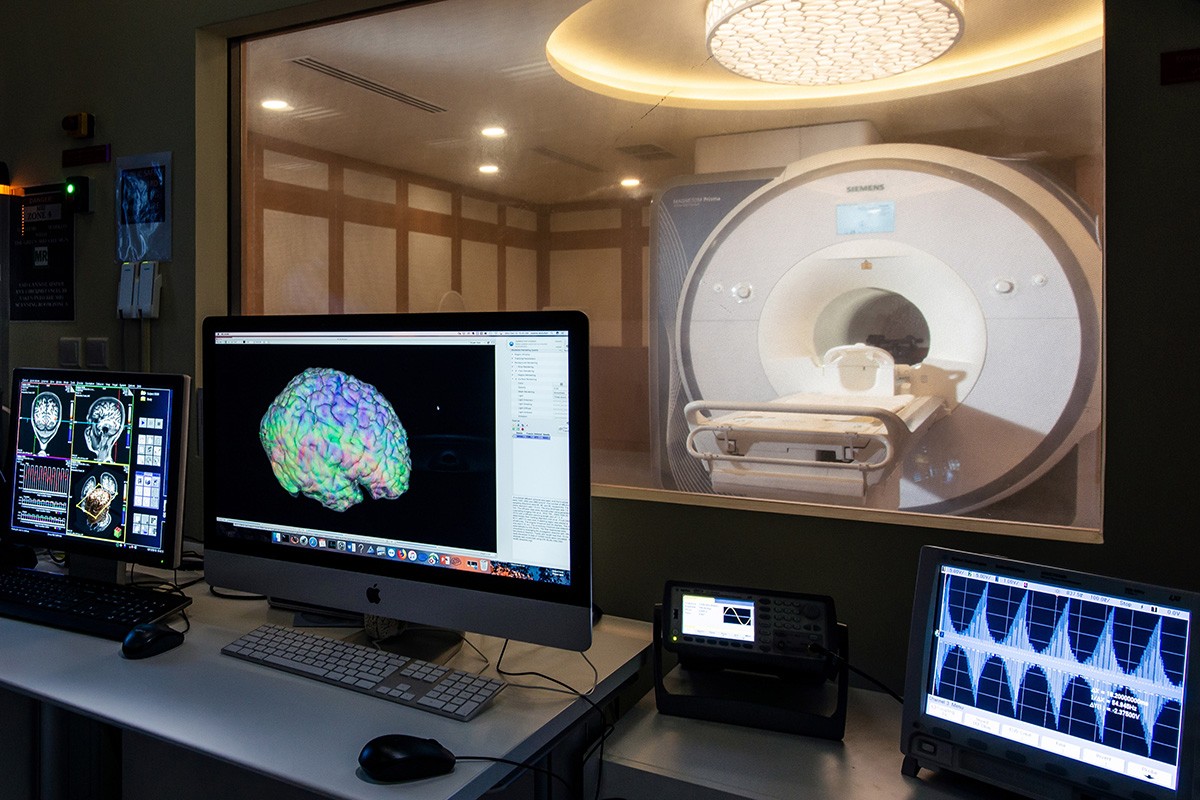
NYUAD is equipped with a 3T Siemens MAGNETOM Prisma MRI scanner and a magnetoencephalography lab.
Current, collaborative and interdisciplinary research projects in the Program of Psychology at NYUAD are focused on a range of areas, including person perception and knowledge; neurolinguistics and language processing; visual perception; prejudice and discrimination; gender inequality; learning and development in children; and the neurobiology of short-term memory. Researchers and students alike have access to state-of-the-art labs and equipment, including an fMRI scanner.
The Psychology faculty fall into two broad areas, namely:
NYUAD is equipped with a 3T Siemens MAGNETOM Prisma MRI scanner and a magnetoencephalography lab.
How do we think, remember, pay attention, communicate, form and implement goals, solve problems, and make decisions? Cognitive psychologists and cognitive neuroscientists at NYUAD use a wide array of methodologies, including behavioral methods, brain imaging techniques, and computational modeling, to investigate how the human brain performs these computations. Research on Cognition and Cognitive Neuroscience at NYUAD includes the following areas:
Research Areas:
Neurolinguistics, Language Processing
Research Area:
How the Human Brain Perceives the Visual World
Research Area:
Perception, Memory
Research Areas:
Cognitive Neuroscience, Perception, Attention, Working Memory, Eye Movements
Research Areas:
Visual Perception; Motion Processing; Depth Perception; Neuroimaging; Virtual Reality
Research Areas:
Short-term Memory, Working Memory
Research Areas:
Neuroscience, Cognitive Systems
Research Areas:
Early Development, Cognition
The Center draws on existing strengths in the domains of Cognition, Health, and Data Science from NYUAD, the UAE, and NYU’s Global Network University (GNU).
The study of perception aims to understand how the human brain interacts with the dynamic world, via perceiving sensory inputs and making sense of them. Researchers in the field of Perception use a variety of state-of-the-art techniques, including psychophysics, eye tracking, movement tracking, computational modeling, and neuroimaging. Perception research at NYUAD includes the following areas:
Research Area:
How the Human Brain Perceives the Visual World
Research Area:
Perception, Memory
Research Areas:
Visual Perception; Motion Processing; Depth Perception; Neuroimaging; Virtual Reality
Developmental Psychology is concerned with the complexity of human development across the lifespan. How do we develop? How do our early experiences shape who we are later in life? How can we support development so that all individuals can reach their full developmental potential? What can we learn about human development from studying individuals in different cultures? At NYUAD, researchers in the field of Developmental Psychology are interested in the following areas:
Research Area:
Child Development, Early Childhood Education, Caregiver-Child Interactions
Research Areas:
Attachment and Autobiographical Memory
Social psychology is the scientific study of how the presence of others and social situations affect our thoughts, feelings, beliefs, and behaviors. Social psychologists at NYUAD conduct experimental studies and statistical analyses of survey data to understand how situational and dispositional characteristics influence our opinions, attitudes, and actions. At NYUAD, research in social psychology is currently investigating questions in the following areas:
Research Areas:
Social Psychology, Prejudice, Discrimination, Intergroup Relations
Research Areas:
Language and Social Cognition; Stereotyping; Psychology of Economic Inequality
Research Areas:
Gender, Inequality, Heteronormativity
Research Areas:
Social Psychology; Poverty; Social Class; Inequality; Ideology; Prejudice; Political Behavior
Research Areas:
Social Psychology, Gender, Stereotyping, Power, Morality