
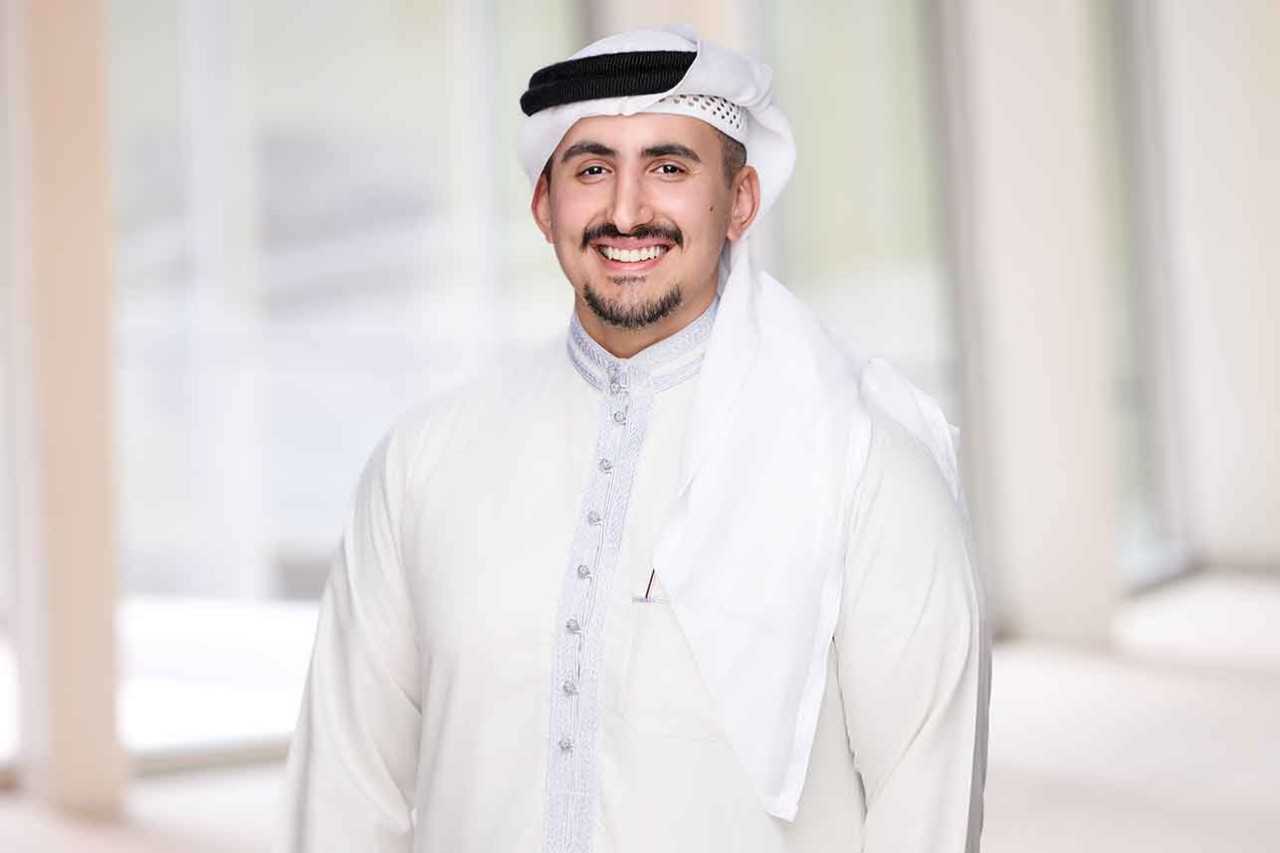

Among the thousands of volumes in his grandfather’s home library in Abu Dhabi, a young Mohamed Al-Mubarak pores over handwritten letters exchanged between his ancestors and the rulers of the Arabian Gulf.
The aging documents carry him back through generations, revealing the customs of his forebears and the ties that bound communities across the Arabian Peninsula.
“There is so much of our social history that has not been written yet,” he says. “As a kid, I had so much curiosity about the relationships between families and why we are so closely knit.”
Today, as a Kawader Research Fellow at NYU Abu Dhabi, Al-Mubarak is investigating the cultural and intellectual history of his homeland. Through literature and music, he is exploring dimensions of everyday life rarely documented in conventional historical accounts.
“A history book can tell you what happened, but there is so much more to the story,” he says. “Through the poetry people wrote and the music they listened to, you begin to understand how they experienced the world, what mattered to them, and what captured their imagination.”
Among the pages of the past
Al-Mubarak spent his childhood summers with his maternal family in Al Hasa, eastern Saudi Arabia. As an only son, he regularly accompanied his father on visits to majlises, where he became curious about the origins of longstanding family friendships.
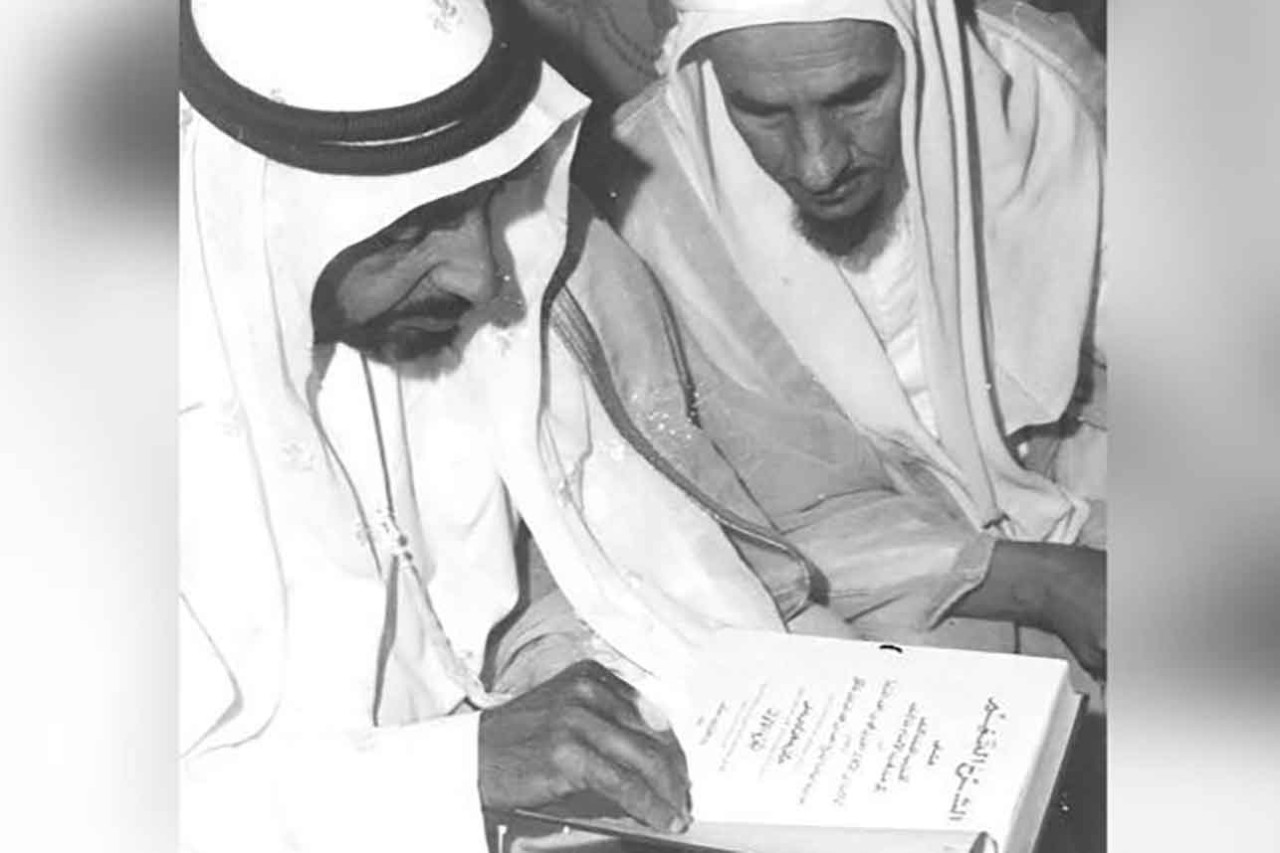
His great-grandfather, Sheikh Ahmed bin Abdelaziz Al Mubarak, who headed the Islamic courts in Abu Dhabi from 1969 to 1988, had amassed a collection of around 4,000 books. The library became a place for Al-Mubarak to pursue the questions that arose during those visits.
After studying history at NYUAD and completing his master’s degree in global history at Humboldt University in Berlin, he returned home, determined to preserve the collection that had inspired him.
While working in theater production at Abu Dhabi’s Cultural Foundation, a chance encounter with the head of the manuscripts department, gave him that opportunity. Walking into his office, Al-Mubarak spotted a photograph of his great-grandfather on the desk. The specialist, who had spent four decades working with manuscripts, had once been his great-grandfather’s student.
“He was glowing with excitement about the project,” Al-Mubarak recalls. “He told me this would be his way of repaying the debt he owed my great-grandfather.”
Under his mentorship, Al-Mubarak began the painstaking process of restoring and organizing the collection. Around 50 manuscripts have been sent for restoration, including one approximately 500 years old.
The library, housed within the family’s public majlis, is now almost ready to welcome visitors. Al-Mubarak plans to register its rare manuscripts and documents in an online catalog, enabling researchers worldwide to locate them and arrange a visit.
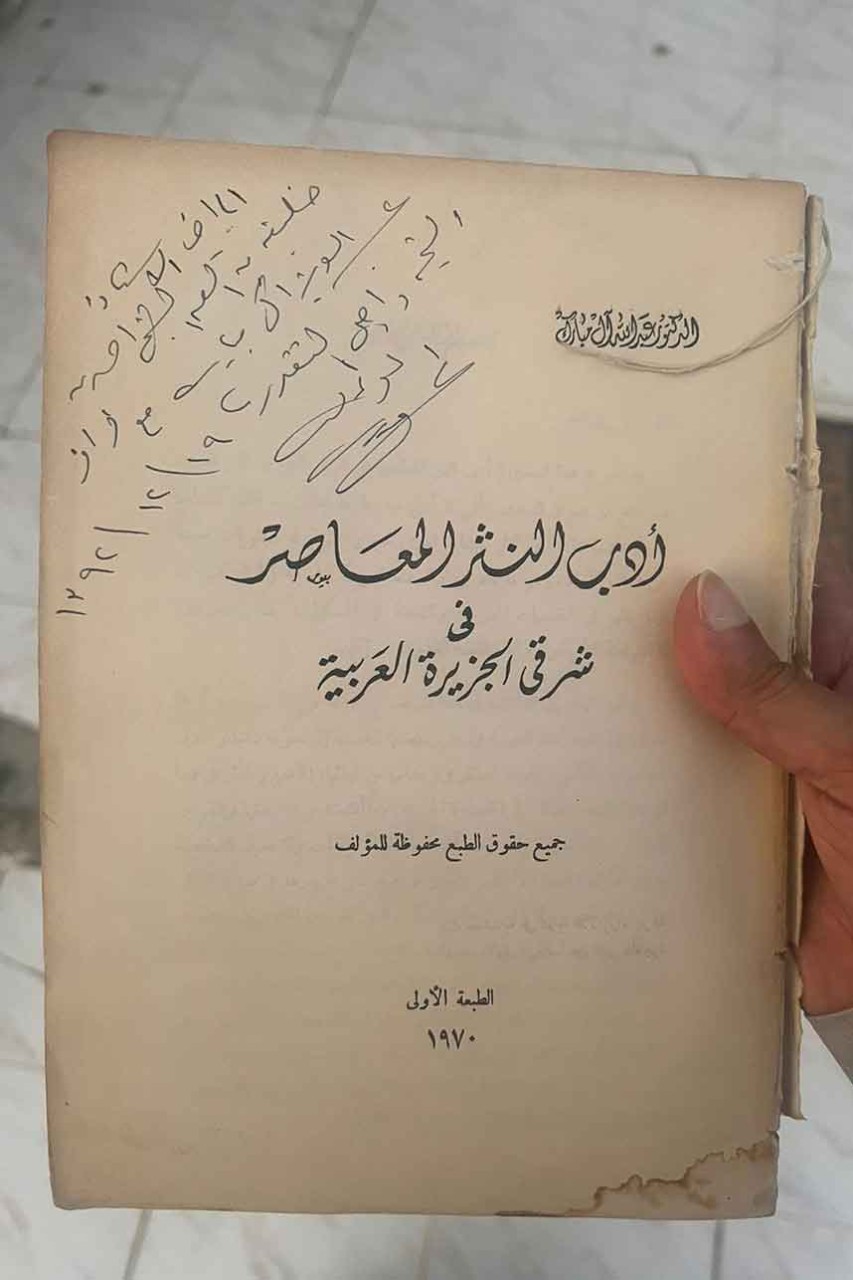
Among his discoveries is a letter from his great-grandfather to Sheikh Shakhbut bin Sultan Al Nahyan, who ruled Abu Dhabi from 1928 to 1966, introducing a relative traveling to Abu Dhabi to research Gulf literature and bearing a gift of dates from the family farm.
Al-Mubarak also found the book that resulted from that visit, a study of prose in Gulf literature published in the 1960s. He hopes to donate both the letter and the book to NYUAD’s Archives and Special Collections.
“I found that very special,” he says. “Someone in my own family was researching Gulf literature more than 60 years ago. His work helped inspire my own.”
The words and sounds of the Gulf
Al-Mubarak is currently studying the work of Emirati poet Mubarak Al Oqaili, whose verse reached audiences through musical recordings. His lesser-known plays and short stories reveal the breadth of intellectual life in the Emirates in the early twentieth century.
In a satirical play written around 1938, Al Oqaili explores the ideals of the League of Nations against a backdrop of international political tensions, including Italy’s invasion of Ethiopia and events in Europe ahead of World War II. In another work, he imagines a future Dubai with towering buildings.
“I found his writing incredibly ahead of its time,” Al-Mubarak says. “I want to share with the world just how engaged Khaleeji intellectuals were with what was happening beyond the region.”
Alongside Brad Bauer, Head of Archives and Special Collections at NYUAD, Al-Mubarak is also developing a publicly accessible archive of Khaleeji music, with plans to acquire an initial collection of 15,000 songs dating from the 1930s to the 1980s. Eventually, he hopes to bring together up to 100,000 songs.
The accompanying receipts, contracts, and correspondence could help reconstruct the commercial history of the Gulf’s recording industry and its connections with musical communities in Bombay, Baghdad, and Cairo.
Songs celebrating the arrival of cars reveal changing consumer tastes, while Indian melodies demonstrate the longstanding cultural exchanges between the Gulf and the Indian subcontinent. The psychedelic rock bands of the 1970s and ’80s, with their flared collars, afros, and electric guitars, capture another fascinating chapter in the region’s musical history.
One song, composed to celebrate Dubai’s 1986 Chess Olympiad, incorporates several genres of Khaleeji music to introduce international visitors to the musical heritage of the Emirates.
“We’re really just scratching the surface,” he says. “I imagine I’ll be very surprised by what else I uncover as I dig deeper.”
A history worth sharing
In the future, Al-Mubarak hopes to pursue a PhD examining the specialized courts that once settled disputes within the Gulf’s pearling industry. Their records could reveal intimate details of the working lives of pearl divers and the communities whose livelihoods depended on the sea.
For Al-Mubarak, history remains inseparable from the place in which he lives. The people whose lives he studies include his own ancestors, and the cultural traditions he documents form part of his own inheritance.
Just as his grandfather’s books inspired him to become a historian, he hopes that encouraging families across the Gulf to share their private collections will open up new possibilities for future generations of researchers.
“Something as simple as a vinyl can tell a larger story about the history of the Gulf,” he says. “There is so much waiting to be uncovered in the homes of people across the region. I want to make those sources available to future researchers so they can tell those stories, too.”
The NYUAD Kawader Research Assistantship Program is a unique, national capacity-building research fellowship program that allows outstanding graduates to gain experience in a cutting-edge academic research environment. This three-year, individually tailored, intensive program offers two distinct paths for Emirati graduates considering a graduate degree or a research career.


