


For Nasser Isleem, language goes far beyond grammar and vocabulary. Instead, it is a living archive of memory, identity, and culture.
Over a career spanning decades and continents, Isleem has focused on integrating culture into Arabic language education, helping students discover that learning a language means learning the stories, values, and traditions that give it life.
As a senior Arabic language lecturer at NYU Abu Dhabi, Isleem is known for his pioneering work in Emirati Arabic, cultural immersion, and innovative language teaching. The roots of that mission can be traced to a defining moment during his own student years.
While studying at Bluefield State College in West Virginia during the Gulf War in 1991, Isleem witnessed growing political tensions and widespread misconceptions about the Arab world.
“I felt I had a responsibility to become a bridge-builder,” he recalls.
What began as a personal commitment evolved into a lifelong mission: teaching Arabic while fostering a deeper understanding of Arab culture among students, faculty, and communities far beyond the classroom.
Teaching the human side of language
Throughout his career, including appointments at the University of North Carolina at Chapel Hill, Duke University, Meredith College, and later NYUAD, Isleem has challenged conventional approaches to language instruction.
Many language learners, he believes, focus too heavily on technical proficiency. While grammar and vocabulary are important, they represent only part of the picture.
“Treating language only as a technical skill misses its human value,” he says.
For him, language is inseparable from culture, social relationships, humor, customs, and shared experiences. When learners encounter a proverb, a joke, or a regional expression, they gain access to a deeper layer of meaning that textbooks alone cannot provide.
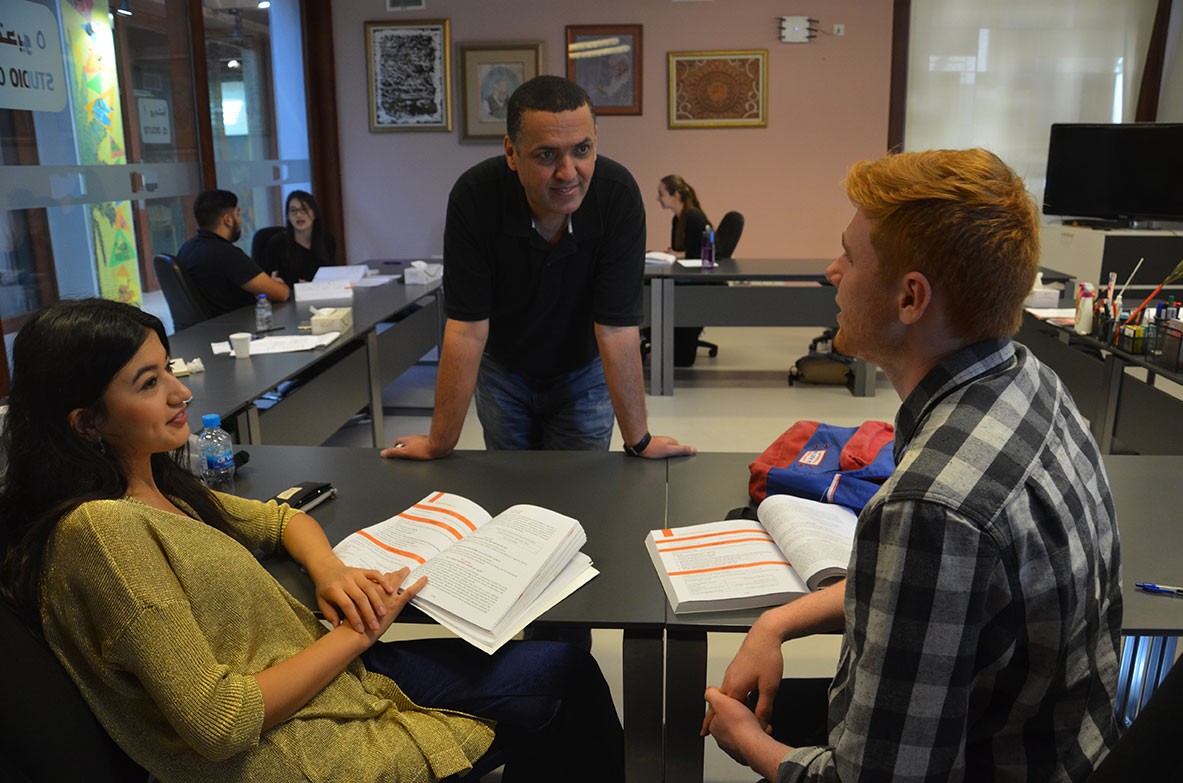
This conviction has shaped much of Isleem’s scholarship. His research examines how proverbs, songs, and cultural expressions can strengthen language skills while deepening cultural understanding. In 2025, he co-authored Proverbs in the Arabic Classroom: Enhancing Language Skills and Cultural Insight, exploring how traditional sayings can strengthen both linguistic competence and cultural awareness.
His work has also produced teaching resources, including the Ramsah textbook for Emirati Arabic, the Kalima wa Nagham textbook series, Arabic Grammar in Action, and other materials designed to connect language learning with cultural understanding.
Immersion as transformation
If there is one initiative that best captures Isleem’s educational philosophy, it is the Emirati Arabic immersion programs he designed and led in Al Ain.
Students live with Emirati families, participate in community activities, explore local traditions, and communicate exclusively in Emirati Arabic. For many participants, the experience is transformative. “Students slept, dreamed, and breathed Arabic,” Isleem says.
Through conversations in family courtyards, gatherings under the stars, and shared meals with their hosts, students gain an intimate understanding of Emirati society and values.
Rather than viewing multiculturalism as simply people from different backgrounds coexisting, he came to understand it as a rich web of relationships, stories, and shared experiences that define life in the Emirates.
For Isleem, such moments demonstrate that meaningful cultural understanding emerges through personal connection.

Preserving the voice of the UAE
The UAE is one of the world’s most globally connected nations, bringing together many cultures. While this diversity is a strength, Isleem believes it makes preserving Emirati Arabic — known locally as Ramsah — even more urgent.
The Emirati dialect carries centuries of history within its words and expressions. Shaped by trade routes and cultural exchanges, it contains linguistic traces of Indian, African, and British influences, reflecting the UAE’s role as a crossroads of civilizations.
When a dialect begins to disappear, Isleem warns, communities risk losing far more than vocabulary.
“Preserving Emirati expression protects the wisdom and intergenerational dynamics that shape the nation’s contemporary identity,” he says.
Storytelling, folklore, poetry, and proverbs have long helped pass knowledge and values from one generation to the next. In Emirati society, these traditions remain deeply embedded in everyday speech. Over nearly fifteen years of teaching and research in the UAE, Isleem has documented numerous examples of this linguistic heritage.
“Studying everyday phrases and proverbs is the best way to understand Emirati hospitality and deep values,” he says.
Through conversations in majlis gatherings and immersion programs across the country, he came to appreciate how spoken language preserves collective memory in ways that written records alone cannot.
Inspiring the next generation
Over his career, Isleem has received many honors, including UNC-Chapel Hill’s Tanner Teaching Award, the Order of the Golden Fleece, and NYU Abu Dhabi’s Shukran Cultural Appreciation Award. Yet the real impact of his work may be the perspectives he has helped shape.
When students leave NYUAD and return to their home countries, he hopes they carry more than language skills, remembering the warmth of Emirati hospitality, the richness of cultural diversity, and the friendships formed across borders.
Most of all, he hopes they leave with a deeper understanding of the UAE, not simply as a place, but as a culture whose stories continue to be told through its language.
For Isleem, every proverb recorded, every cultural expression explained, and every student immersed in Emirati life contribute to a larger purpose: ensuring that the UAE’s heritage continues to be heard, understood, and appreciated by future generations.


