As the sun rises behind the Hajar Mountains, the valley of Siji slowly comes into view. Date palms, farms, and rocky slopes catch the first light, water glistens in the dam below, and the pale stone begins to warm with the day.
For Emirati artist Roudhah Al Mazrouei, this landscape is more than a backdrop — it is a collaborator, an archive, and a home.
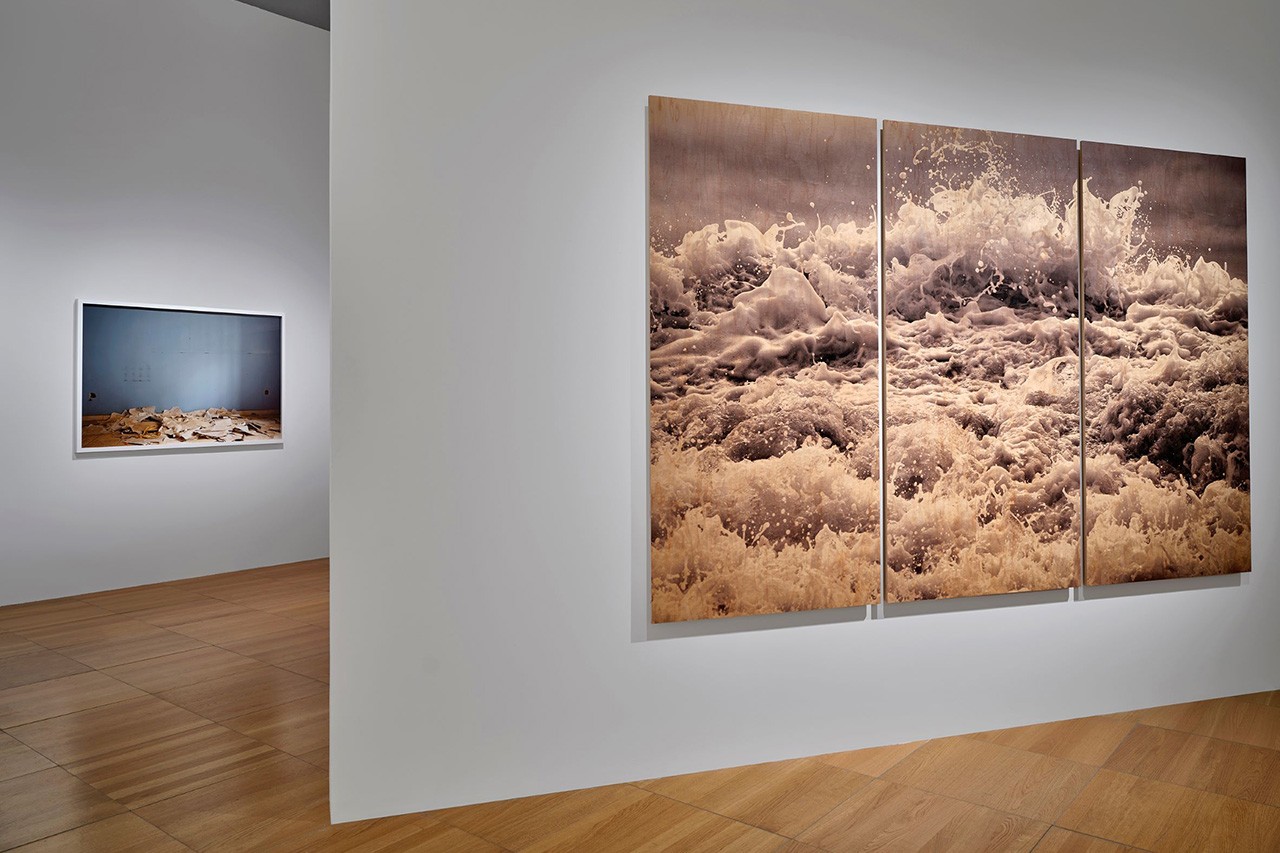
Al Mazrouei works primarily in oil painting alongside film, sculpture, and printmaking to capture the towns and villages of the northern Emirates. Yet it is her ancestral home, Siji in Fujairah, that she returns to again and again.
“My work is an ongoing love letter to Siji,” she says. “Not only because my grandmother, who is no longer with us, used to live there, but also to the roots and stories that connect me to the land.”

Alongside her visual practice, Al Mazrouei is a Kawader Research Fellow at Al Mawrid Arab Center for the Study of Art at NYU Abu Dhabi, working with art historian Salwa Mikdadi and Visiting Professor of Art History Nada Shabout on cultural memory, ecological heritage, and overlooked landscape archives.
“So much of Gulf art and landscape lives outside official records,” she says. “My research is about listening to those quieter histories and finding ways to place the Gulf on the map in its own terms.”
Finding her own ground
Al Mazrouei grew up in Al Ain, gravitating towards art from her early childhood. At the same time, her parents encouraged a more conventional path, suggesting engineering or architecture as a safer option.
After a year of a civil engineering degree, she craved creativity and switched to a double track in fine art and art history at NYUAD, graduating in 2024.
For her Capstone project, she decided that simply painting the landscape was not enough.
“I wanted the work to feel like a collaboration with the land,” she explains. She asked her father to bring rocks from Siji, to ground them into pigments, and use them with charcoal and natural fibers from the local environment.
“I did not want just to paint a mountain that people might recognize,” she says. “I wanted the land itself to be present in the work, so when you stand in front of it, you are not only looking at Siji, you are almost standing inside a piece of it.”
Determined to show art could be a serious career, she attended talks and openings, gradually moving from visitor to participant. Her first substantial role was an internship at Abu Dhabi arts campus 421, before moving to London for an MFA at the Royal College of Art.
London, she says, felt like “home away from home.” She learned from the city’s art scene, attending fairs and exhibiting in group shows and residencies. While abroad, she applied for the Kawader Fellowship, building on a relationship with Mikdadi that began in the classroom.
Now, her research explores Khaleeji nomadic art and the Gulf as a lens for art and history, authoring studies on the region’s art education and women’s societies.
Her projects draw on oral histories, community archives, and non-formal education spaces such as artist-run clubs and societies, treating them as primary sources for understanding how art has developed in the Gulf.
“The research and the art feed each other,” she says. “The more I study Gulf art histories and listen to people’s stories, the more depth I can bring back into the work.”
From campus structure to national landmark

Her entry into public art began at NYUAD, when two civil engineering friends invited her to join their application for the Christo and Jeanne-Claude Award. They brought the calculations; she brought the design.
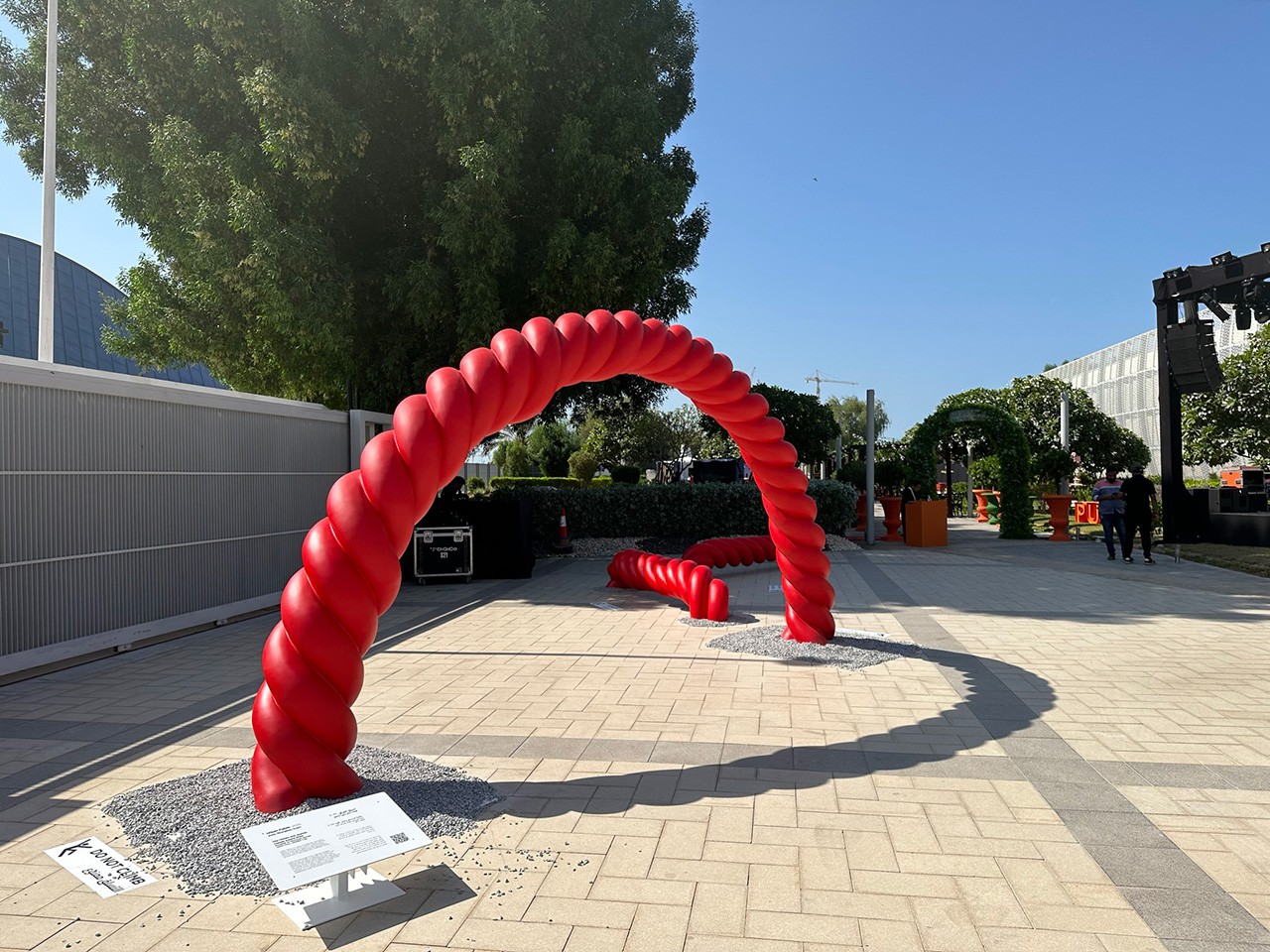
Their proposal won, and the resulting sculpture, Urban Fabric, debuted at Abu Dhabi Art in 2022 before moving to NYU Abu Dhabi and then Umm Al Emarat Park. It is now permanently installed at Rabdan Marina.
Seeing something you drew become a structure people walk around is very different from seeing a painting on a wall. It opened a door.
That experience led to further open calls and commissions with government entities. In October 2026, she unveiled Tassa at Al Towayya Roundabout in Al Ain, a commission for the Public Art Abu Dhabi Biennial.
The 80 x 80 meter steel structure was inspired by traditional Emirati head jewelry, turning an ordinary junction into a permanent landmark-scale artwork.
Her practice also extends into residencies and galleries. She recently spent a month at an artist residency at Colstoun House in Haddington in Scotland, and presented a solo booth at Art Dubai that sold out within hours.
In December, she will open her first solo exhibition at Taymour Grahne Projects in Alserkal Avenue and hopes to open her own studio before pursuing a PhD that combines art practice and research in the future.
“I want the Gulf to appear on the map in its own way,” she says. “Not by copying someone else’s model, but by letting our landscapes and histories stand on their own stage.”
Through it all, Siji remains the quiet starting point. “This place shaped me,” she says. “Every time I return to it in my work, it feels like writing another chapter of its history.”