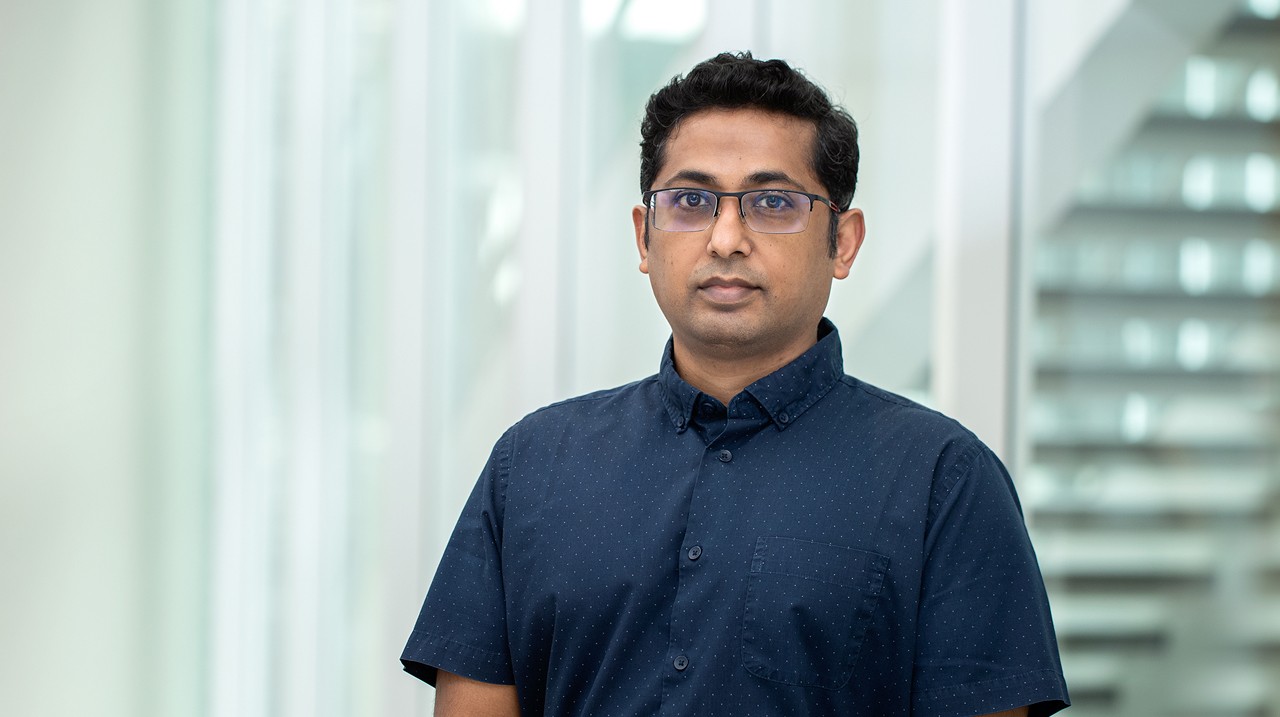
Ramesh Jagannathan spent much of his career turning light into images. By the time he retired, he was one of the field’s foremost innovators, holding more than 50 US patents. Yet, his curiosity was far from exhausted.
When an invitation from NYU Abu Dhabi to help build an innovation hub in the UAE arrived, it immediately sparked his interest. “It felt like a new frontier,” he says. “A chance to build something that mattered.”
A self-described “entrepreneurial technologist,” he has spent a lifetime moving between research, industry, and education — always guided by a personal rule: reinvent yourself every five years. “It keeps you uncomfortable,” he says. “Every time you start over, you realize how much you don’t know. But that’s where discovery happens.”
Jagannathan’s own reinventions have been far-reaching. After completing a PhD in chemical engineering at Clarkson University in New York, Jagannathan joined Eastman Kodak in the US, where he spent three decades transforming ideas into technologies that shaped the modern imaging industry.
“I became fascinated with silver halide crystals — the light sensors inside traditional film,” he says. “Understanding their behaviour was like decoding nature itself.”
That fascination led to countless patents and innovations that underpinned Kodak’s multibillion-dollar photographic platforms.

“I started as an engineer and became a technologist,” he says. “At Kodak, you learned that invention alone wasn’t enough. You had to scale it, manufacture it, and make it work in the real world.”
Coming to Abu Dhabi
That same curiosity brought him to Abu Dhabi in 2009 as one of NYUAD’s founding faculty members. Tasked with helping build the engineering division, he quickly found a new challenge for his entrepreneurial mindset.
“It was a rare opportunity to help design an institution and an innovation ecosystem at the same time,” he says.
The UAE’s growing focus on technology and diversification soon created the ideal environment for his ideas. The government turned to Jagannathan to design a platform that could connect global startups, investors, and researchers — and startAD was born.

“The brief was simple,” he says. “Build an entrepreneurial engine for the nation.” Since then, startAD has supported more than 300 startups, created hundreds of jobs, and helped participants raise millions of dollars in funding. It has also become a model for ecosystem building in emerging markets.
Jagannathan credits its success to inclusion and accessibility. “We didn’t want just another accelerator,” he says. “We wanted to democratize entrepreneurship, to make it possible for anyone with an idea to test it, scale it, and bring it to market.”
That philosophy has led to initiatives such as the Emirati Women Achievers Program, which trains female entrepreneurs to launch and lead ventures across the UAE. “If you want a strong ecosystem,” he says, “you have to make sure everyone in it can rise.”
Even as he builds programs that look outward, Jagannathan’s own research remains deeply technical. In his Nano and Biomaterials Research Lab, he studies ultra-thin materials, including a gold-based crystal he calls Goldene, that could redefine future electronics.
“It’s one atom thick and shows extraordinary properties,” he explains. “It could lead to new transistors or help break down microplastics in water. Imagine a material that solves two of humanity’s biggest problems — energy and pollution — at once.”
That blend of scientific precision and entrepreneurial daring defines his outlook on Abu Dhabi’s future. “The UAE has imagination,” he says. “It’s not weighed down by legacy systems. That gives it agility, and agility is what drives innovation.”
Abu Dhabi is the next frontier of innovation
Jagannathan believes the emirate is poised to become a hub for what he calls the ‘Goldene Valley’ — the next generation of technological revolutions emerging across the Middle East, Africa, and South Asia.
“For decades, Silicon Valley symbolised the frontier of innovation,” he says. “Now, the next wave can come from this region, where the world’s next billion middle-class citizens are thriving. If we design for their realities and needs, we can build something transformative.”
After half a century spanning continents, industries, and disciplines, Jagannathan remains animated by the same curiosity that first drew him to science.
“I want to inspire people to dream big. Take calculated risks. Don’t be afraid of failure. Life is full of opportunities, and we discover ourselves through what we do,” he says.
“That discovery process should never stop. It’s not about money or fame, it’s about growth, and the peace that comes from finding purpose.”