
Tej-eddine Ghoul
Professor of Mathematics; Global Network Professor of Mathematics, Courant Institute of Mathematical Sciences
Affiliation: NYU Abu Dhabi
Education: MA, University of Paris 6 and (Ecole National des Ponts et Chaussees ) PhD University of Paris 13
Research Websites: Center for Stability, Instability, and Turbulence
Research Areas: Partial Differential Equations
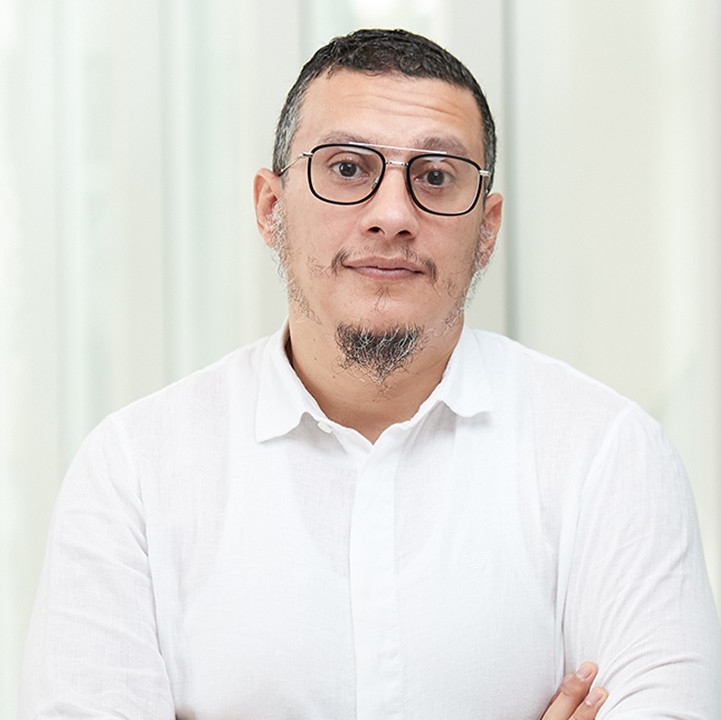

Tej-eddine Ghoul is a Full Professor of Mathematics at NYU Abu Dhabi and a co-principal investigator at the Research Center on Stability, Instability and Turbulence. He earned his PhD from the University of Paris 13 before spending two years as a Courant Instructor (Assistant Professor of Mathematics) at New York University in New York, where he taught Calculus and Linear Algebra. Before his doctoral studies, he worked for one year at the French Atomic Energy Commission (CEA) on laser-induced breakdown spectroscopy (LIBS), a technique that uses laser pulses to identify the chemical composition of materials.
His research explores the mathematics behind phenomena in physics, chemistry, and biology. He studies nonlinear partial differential equations, which describe how quantities such as temperature, fluid velocity, or the concentration of a substance change over space and time. These equations can capture complex behavior because the quantities involved influence one another, sometimes producing dramatic changes.
A central focus of his work is understanding how singularities form. These occur when a mathematical model predicts that a quantity, or the rate at which it changes, becomes unbounded. This behavior is often called “blow-up” when it happens within a finite time. His research seeks to explain when and how this happens, describe the patterns that emerge near a singularity, and determine whether those patterns persist when the initial conditions are slightly changed.
He also studies the long-time behavior of solutions: how a system evolves over extended periods, whether it approaches a steady state or a recognizable pattern, and how its eventual behavior depends on where it began. Through this work, he aims to identify mathematical principles that help explain the behavior of complex systems.