
Aikaterini Arfara
Associate Professor of Theater Performance Studies; Global Network Associate Professor of Theater, Performance Studies, Department of Undergraduate Drama Tisch School of the Arts; Affiliation: Department of Drama, Tisch School of the Arts
Affiliation: NYU Abu Dhabi
Education: PhD in Art History, Paris I – Panthéon/Sorbonne University; MA in Theatre Studies, Athens University; BA in Theatre Studies, Athens University; BA in Classics, Athens University
Research Areas: Public and socially engaged art; Colonial botany; Energy transitions; Crosscurrents of empire and the politics of human and other-than-human representation
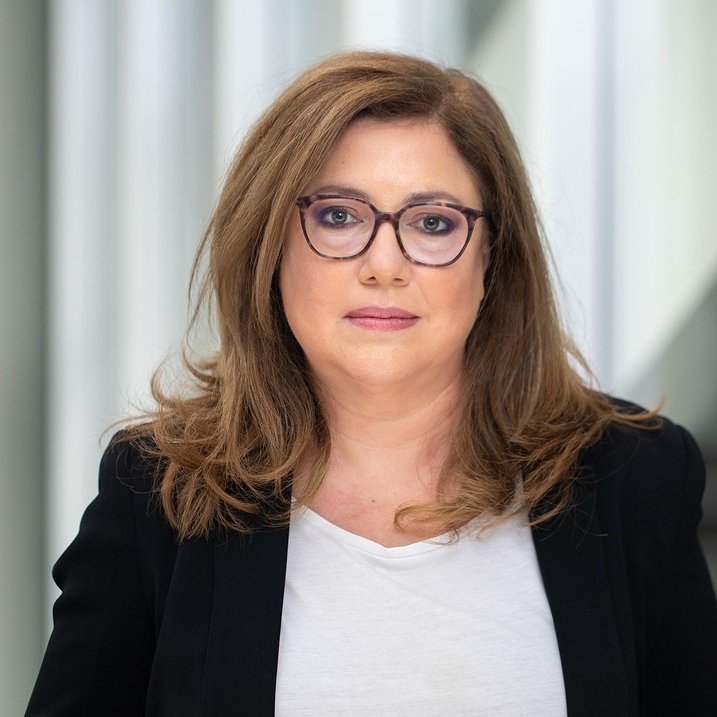

Katia Arfara is Associate Professor of Theater and Performance Studies at NYU Abu Dhabi, affiliated with the Department of Drama at the Tisch School of the Arts, and an independent curator. Her scholarship and curatorial work focus on the politics of human and other-than-human representation in relation to migration, ecology, memory, and public space. Before joining NYUAD, she served as Theater and Dance Artistic Director and curator at Onassis Stegi in Athens, Greece, where, over a decade, she curated more than 600 projects in theater, performance, dance, and the visual arts, including stage performances, indoor and outdoor multimedia installations, urban festivals, and site-specific exhibitions. Her curatorship and scholarship form a single continuum, inspiring and shaping one another.
Arfara’s scholarly work comprises one monograph, Théâtralités Contemporaines: Entre les Arts Plastiques et les Arts de la Scene (Peter Lang, 2012); one co-edited volume, Intermedial Performance and Politics in the Public Sphere (Palgrave Macmillan, 2018); two special issues of Théâtre/Public (2016), and Alternatives Théâtrales (2005) journals; and numerous publications, ranging from single-authored and co-authored research articles in area studies journals and edited volumes to catalog essays and long-form reviews of performances and books. Her academic work has been published in English, French, Greek, Spanish, and Arabic, contributing to scholarship across Europe, North and South America, Southeast Asia, East Asia, and the Middle East. Arfara’s most recent book, Curating the Commons. Socially Engaged Public Art (University of Michigan Press, 2025), has been presented at academic and cultural institutions across three continents, engaging audiences in theatre and performance studies, art history, curatorial studies, and the social sciences. Building on the French philosopher Henri Lefebvre’s theories of social space and the right to the city, alongside current debates on the commons, she advocates a slow curatorial approach and complicates notions of agency, mobility, and belonging in order to reclaim public space as a commons. Drawing on her dual perspective as scholar and curator, Arfara offers a grounded account of site-specific projects she curated in atypical urban spaces in Athens during the austerity years, contributing to broader efforts to craft more-than-human narratives in response to global eco-social urgencies.
Her current research project, de/colonial botany, investigates how the “tropical” natural world was extracted, classified, reproduced, and objectified through World’s Fairs, botanical gardens, and natural history museums. The project has grown out of conferences, essays, papers, and visiting fellowships, including the Ishibashi Foundation/The Japan Foundation Fellowship in 2025, which enabled her to examine evolutionary aesthetics in Meiji Japan, with particular attention to the curatorial work of Okakura Kakuzō. Arfara is currently working on an edited volume that further investigates the botanical “exhibitionary complex” from historical and contemporary perspectives, engaging directly with current debates on mobility, provenance, foreignness, repair, and the politics of plant representation. Arfara’s years-long research on performance and its intersections with urban ecologies and worldmaking has expanded to incorporate the Gulf’s multifaceted artistic scene, which has challenged assumptions and theories about human-nature interconnectedness. Her research on the region’s pearl and oil culture has developed through talks, conferences, exhibitions, and essays, as well as participation in energy humanities research groups, including the Elements Pod in NYUAD’s “The Anthropocene” Research Forum, and the Georgetown University in Qatar's Program in Energy Humanities.
Arfara’s research has been supported, among others, by the Fulbright Foundation, the DAAD, the Clemens Heller Program, the Seeger Center for Hellenic Studies at Princeton, and the Saison Foundation, as well as a number of research grants at NYUAD. She has taught, lectured, and given workshops globally, namely at University Paris 1 Panthéon-Sorbonne, Paris III-Sorbonne Nouvelle University, Sorbonne University, Athens School of Fine Arts, Aristotle University of Thessaloniki, The New School, Waseda University, University of Picardy Jules Verne, York University, Ghent University, and University of Bologna, among others.