
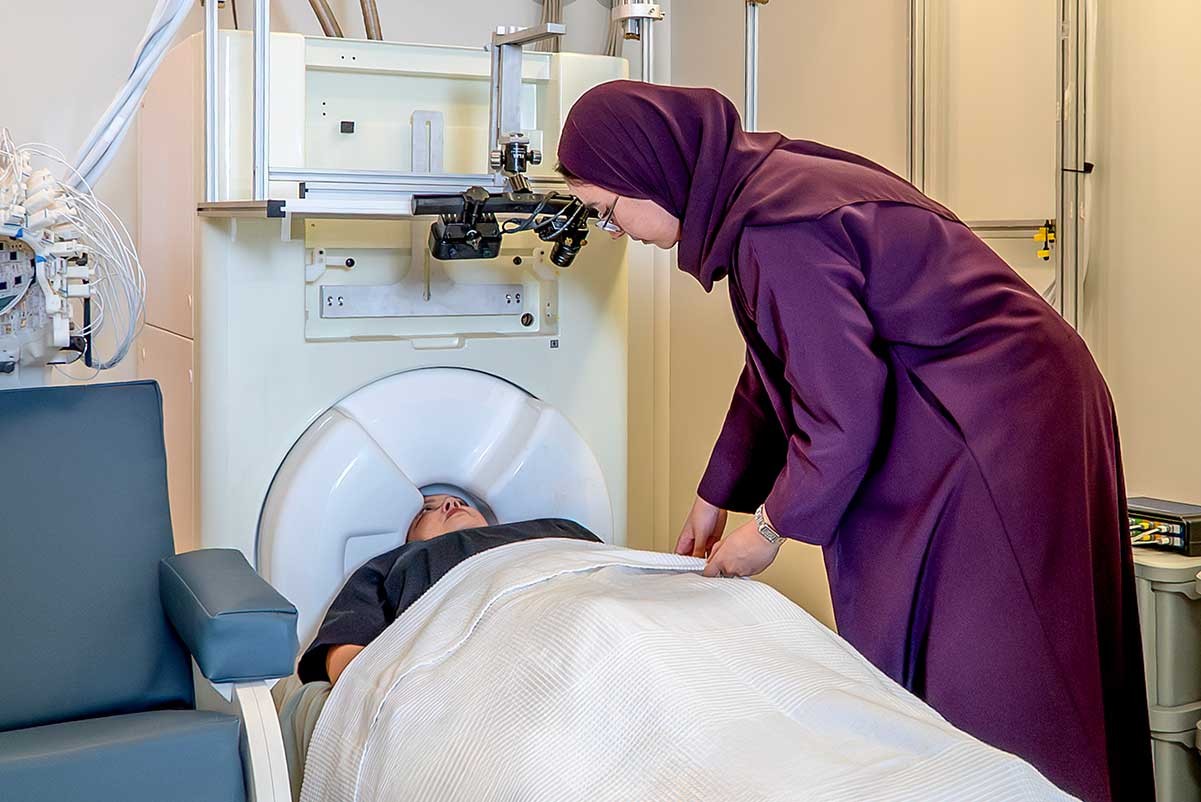
A soft mechanical whir fills the room while Arabic words flash across the screen in a magnetically shielded chamber.
Inside the windowless cube, a volunteer reads each word as it appears. Outside, at NYU Abu Dhabi’s Center for Brain and Health, Emirati research assistant Maitha AlShaali watches a monitor track the brain’s response in the split second it takes to read.
For AlShaali, those fleeting moments could help explain how children learn to read and provide doctors with new insights into neurological conditions.
Her work under Professor of Psychology David Melcher focuses on how the brain processes written Arabic, with potential applications ranging from reading support for children with dyslexia and ADHD to better understanding epilepsy.
“The main question I’m trying to answer is what makes Arabic unique in the way we read and understand it, and what that can teach us about human cognition more broadly,” she says.
Exploring how the brain navigates the Arabic script
As a child, AlShaali was drawn to big questions.
“I was thinking about space exploration and marine biology,” she recalls. “Then I realized the human brain is just as underexplored as space or the deep sea.”
Growing up in the UAE, she took that curiosity into a psychology degree at Zayed University in Dubai. There she discovered neuroscience and joined a research project on how the brain reads Arabic, a language central to her identity but surprisingly understudied in science.
That interest eventually brought her to NYUAD as a Kawader Fellow, where she now focuses on Arabic language processing in adults and children.
One of her central projects examines visual crowding, the difficulty of picking out one object when similar objects are packed closely together.
Arabic offers a particularly revealing test case. Unlike most Latin scripts, Arabic is semi-cursive. Some letters connect, others do not, and their form changes depending on their position in a word. That connectivity and tight spacing can increase visual crowding.
“Some studies have found differences in brain activity between Arabic and other writing systems, potentially related to Arabic’s visual complexity, connectivity, and the similarity of certain letter forms.”
When AlShaali joined NYUAD, she revived an experiment on Arabic reading, redesigning it to examine how letter connectivity and inter-letter spacing affect eye movements and brain responses.

Participants fix their gaze on a point at the center of the screen while words flash briefly to either side just outside their direct line of focus, then reappear in the middle. This captures the preview effect in natural reading: readers begin processing an upcoming word in peripheral vision before directly looking at it. The researchers vary their spacing and connectivity to see how these features affect reading.
An eye-tracker records where participants look and how long they linger on each word. At the same time, a magnetoencephalography (MEG) scanner, which is a medical device that maps brain activity, records the brain’s tiny magnetic signals with millisecond precision. Together, the two systems show where Arabic words are processed in the brain and when different stages of reading occur.
One question is whether less experienced readers benefit more from separated letters, while experienced readers benefit from the familiar connected forms of Arabic words. AlShaali’s research aims to explore how proficiency and exposure may impact Arabic language processing, as well as how the brain responds to morphological and orthographical features of the language itself compared to other languages.
Research with a purpose
The work is technical, but its aims are practical.
In collaboration with the National Academy for Childhood Development, AlShaali is applying these insights to children aged eight to 12, including those with dyslexia and ADHD. The team aims to identify which features of Arabic script make reading easier or harder and to use that knowledge to support children as they develop Arabic reading skills.
“Early, targeted support can make a meaningful difference for children with dyslexia, particularly during the critical stages when foundational reading skills are developing,” she adds.
A second line of research extends into clinical care. Partnering with Cleveland Clinic Abu Dhabi, AlShaali contributes to a study of epilepsy patients examining how their brains process spoken Arabic, to help clinicians localize seizures and inform presurgical planning.
The collaboration gives clinicians a clearer picture of individual cases while allowing researchers to study how language processing in people with epilepsy differs from that of neurotypical participants.
Preserving the Arabic language
For AlShaali, the project is also about Arabic itself. She sees her research as part of a broader effort to strengthen the language in education and science, in step with UAE national initiatives. In a fast-growing, internationally connected country where children encounter English daily, she argues that a strong foundation in Modern Standard Arabic and local dialects is essential.
AlShaali wants to carry these questions into graduate study and a research career that keeps Arabic at its center.
“The goal of research is always to ask more questions and try to answer them with the resources we have as human beings,” she says. “The impact isn’t always immediate, but each answer brings us closer to understanding ourselves.”
The NYUAD Kawader Research Assistantship Program is a unique, national capacity-building research fellowship program that allows outstanding graduates to gain experience in a cutting-edge academic research environment. This three-year, individually tailored, intensive program offers two distinct paths for Emirati graduates considering a graduate degree or a research career.