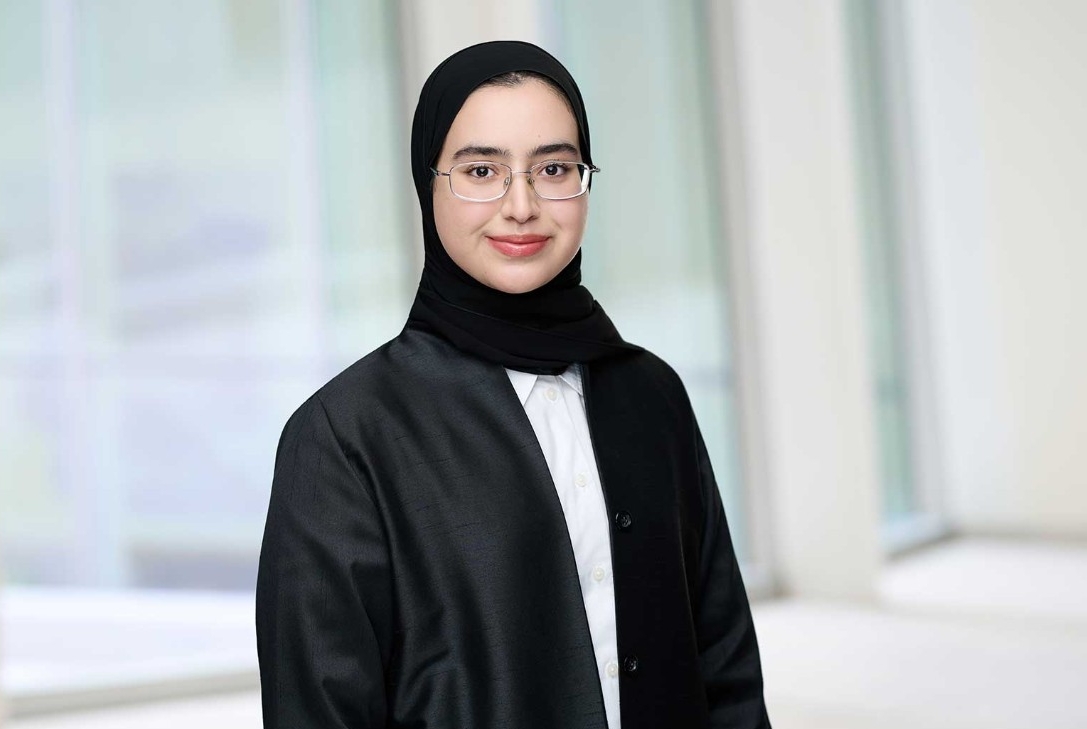
Empty oil and gas reservoirs are not the end of a story for Maithah Alaleeli. For the Emirati engineer, they are the starting point for a different kind of future where the spaces that once powered industry help protect the climate.
In her work, the question is no longer how much can be taken from the ground, but how much harmful carbon can be put back in.
As a Kawader Fellow in Engineering at NYU Abu Dhabi working with Professor Mostafa Mobasher, Alaleeli is studying how to inject carbon dioxide (CO₂) into the UAE’s underground rock so it remains there safely.
“If companies here can safely inject CO₂ where oil and gas once were, it can directly reduce what we release into the atmosphere,” she says. “That has a real impact on the climate and on the UAE’s future.”
Building on solid ground
After graduating with a Master of Science degree in nuclear science and engineering, she worked on energy projects for ADNOC, which sharpened her interest in infrastructure mechanics. In 2020, she returned to the classroom, embarking on a PhD in nuclear engineering where she developed computer models to study the performance of advanced materials in extreme conditions.
Her computational and mechanical expertise led to her current role at NYUAD, where she tackles one of the central questions in climate action: how to capture CO₂ and keep it out of the atmosphere in a way that is both safe and practical for industry.
The concept builds on familiar oil and gas practice. When petroleum and natural gas are extracted from underground reservoirs, they leave behind cavities underground. Companies will inject water into these voids to help push more oil and gas toward production wells. The idea now is to inject captured CO₂ instead of water.
“While you’re taking out the oil and gas, you can pump in CO₂ from the environment,” she explains. “The wells and equipment exist, which makes storing CO₂ more practical.”
Once underground, the CO₂ does not simply remain as a gas. Over time, it can react with the rock itself, dissolving minerals and then forming new ones, effectively turning the carbon into solid stone. That process is natural, but to rely on it at scale, engineers must understand how it behaves under real reservoir conditions: high pressure, high temperature, and existing cracks in the rock.
A blueprint for the UAE
Most models used today are developed elsewhere in the world and designed for sandstone formations. The UAE’s subsurface is different. It is dominated by limestone and other carbonate rocks, which are more reactive and undergo a sharper cycle of dissolution and re-formation.
“The limestone here behaves differently,” Alaleeli says. “The mechanics community doesn’t really have a model for these rocks, so we’re trying to build it.”

Currently, Alaleeli models how CO₂ moves and reacts in local rock — how quickly it travels through fractures, how the rock changes, and which injection pressures are safe. Her goal is to provide companies with clear guidance on securely storing carbon in the UAE’s geology.
The project is still in its early stages with Alaleeli being the first researcher in the research group.
Giving back and looking ahead
Working on this problem in the UAE is a deliberate choice for Alaleeli.
“I think something embedded in a lot of Emiratis is that they always want to give back to the country,” she says. “You go abroad, get that knowledge, and your motivation is to come back and give back.”
Alaleeli is focused on building a path to a future faculty role. Over the next five to 10 years, she hopes the models developed in her group will help major UAE companies capture CO₂ directly from their factories and work with national operators to inject it into former oil and gas reservoirs.
For her, that work is part of a broader national story rather than a lone effort.
“The foundations are already here,” she says. “My role is to add one more layer that helps the UAE and the climate in the years to come.”
The NYUAD Kawader Research Assistantship Program is a unique, national capacity-building research fellowship program that allows outstanding graduates to gain experience in a cutting-edge academic research environment. This three-year, individually tailored, intensive program has two distinctive paths designed for Emirati graduates considering a graduate degree or a research career.