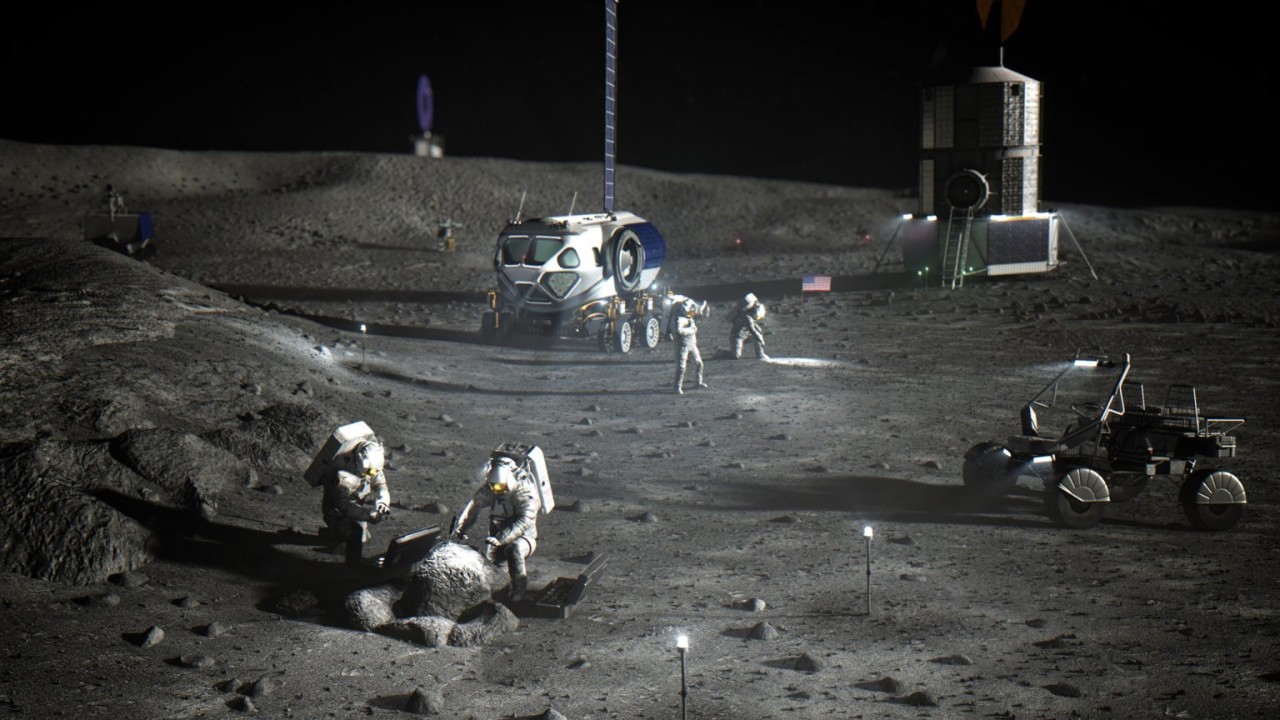
More than fifty years after Apollo, Dimitra Atri is asking a harder question — not whether humans can visit the Moon, but whether they can stay.
At the NYU Abu Dhabi Space Exploration Laboratory, Principal Investigator Atri is helping prepare for the UAE’s return to the lunar surface, tackling the challenges that could determine whether humans can one day live and work beyond Earth.
His team is focused on three problems that will be critical to making that possible: whether life’s chemical building blocks can survive on the Moon, how lunar dust damages equipment, and how radiation affects astronauts.
The lab has developed three experiments for the Emirates Lunar Mission. One will test ideas Atri has explored through computer models and data from orbiters and rovers.
“I have spent years modeling radiation and surface chemistry on worlds we could only observe from orbit or through rover data,” he says. “Now we get to send our own experiment, which we designed and built ourselves, and test our ideas directly on the lunar surface. That is a rare privilege for any planetary scientist.”
For Atri, the mission is more than a scientific milestone; it shows how Abu Dhabi’s research can contribute directly to global space exploration.
Building for survival

Long stays on the Moon require reliable habitats, radiation protection, autonomous systems, durable equipment, and the use of lunar resources.
“We are building the infrastructure,” Atri says. “Landers, rovers, habitats, resource-extraction technologies, lunar simulants — everything needed for sustained exploration.”
Every instrument must survive launch, temperature extremes, radiation, and vacuum. Designing for spaceflight takes years of engineering and testing.
At NYUAD, students and researchers participate directly. The lab combines planetary science with facilities for making lunar-soil simulants, testing in vacuum, and modeling radiation across planetary surfaces.


One experiment examines how amino acids — the building blocks of proteins — survive lunar radiation and the vacuum of space.
The question extends far beyond the Moon. Scientists have detected organic material in meteorites and are searching for it on Mars and the icy moons of Jupiter and Saturn. Understanding how amino acids change when exposed to space can help researchers interpret what future missions find.
If these molecules survive, life’s building blocks may persist in more places. If not, scientists may need to reconsider where and how to search for organics.
The experiment will not determine whether life exists elsewhere. It will, however, add evidence to a more fundamental question: how common are the conditions that make life possible?
Tackling Moon dust and radiation
Chemistry isn't the only challenge astronauts will face — the Moon's surface itself poses a problem.
Lunar dust, also known as regolith, caused serious operational problems during the Apollo missions. Its microscopic particles are sharp, abrasive, and electrically charged. They cling to equipment and spacesuits and can enter mechanical systems.
“It gets into seals, joints, and lungs,” Atri says. “It degrades equipment and was one of the biggest operational risks reported during Apollo.”
Apollo astronauts remained on the lunar surface for days. Future crews may stay for months.
Controlling dust will be essential for astronaut safety and equipment longevity. Without solutions, lunar dust could make long missions more dangerous and costly.
Recreating lunar soil using UAE rocks
Atri’s team also recreates lunar soil using UAE rock. Producing this locally lets researchers test equipment and build scientific capability in the UAE.
Radiation is the final challenge Atri addresses. Earth’s atmosphere and magnetic field protect people from much of the high-energy radiation traveling through space. Beyond that protection, exposure increases significantly. Over time, it can damage cells, raise cancer risk, and affect the nervous system.
“If we don’t understand and mitigate this through shielding, mission timing, or habitat design,” he says, “long-duration missions to the Moon or Mars simply aren’t safe.”
His laboratory models radiation environments across the Moon, Mars, and other planetary surfaces. These models can help scientists identify where exposure is greatest, estimate how much protection astronauts may need, and inform decisions about where habitats should be located.
The practical outcome is clear: better radiation data can help mission planners reduce risks for the people who will live and work beyond Earth.
Training the next generation
Students in the Space Exploration Laboratory gain hands-on experience in designing experiments, analyzing planetary environments, and contributing to research connected to international missions.
For many, it is their first opportunity to work on an experiment that could eventually leave Earth.
NYUAD now has laboratory infrastructure, a thermal-vacuum chamber, lunar-simulant production, a lunar testbed, and radiation-modeling capability. Together, these facilities allow us to develop experiments here and help train the next generation of scientists and engineers in the UAE.
Twenty years from now, Atri hopes humanity will have established a permanent presence on the Moon, launched crewed missions to Mars, and moved closer to answering one of science’s oldest questions: are we alone?
His own ambition is both bold and tangible.
“I would like to have a small version of our lab on the Moon, operated remotely from our campus here,” he says. And for Atri, the Moon’s the limit.