
A four-legged robot moves through an underground arena as cameras track its every step. Overhead, a motion-capture system follows its movements, robotic arms stand ready nearby, and drones wait inside a netted flight zone.
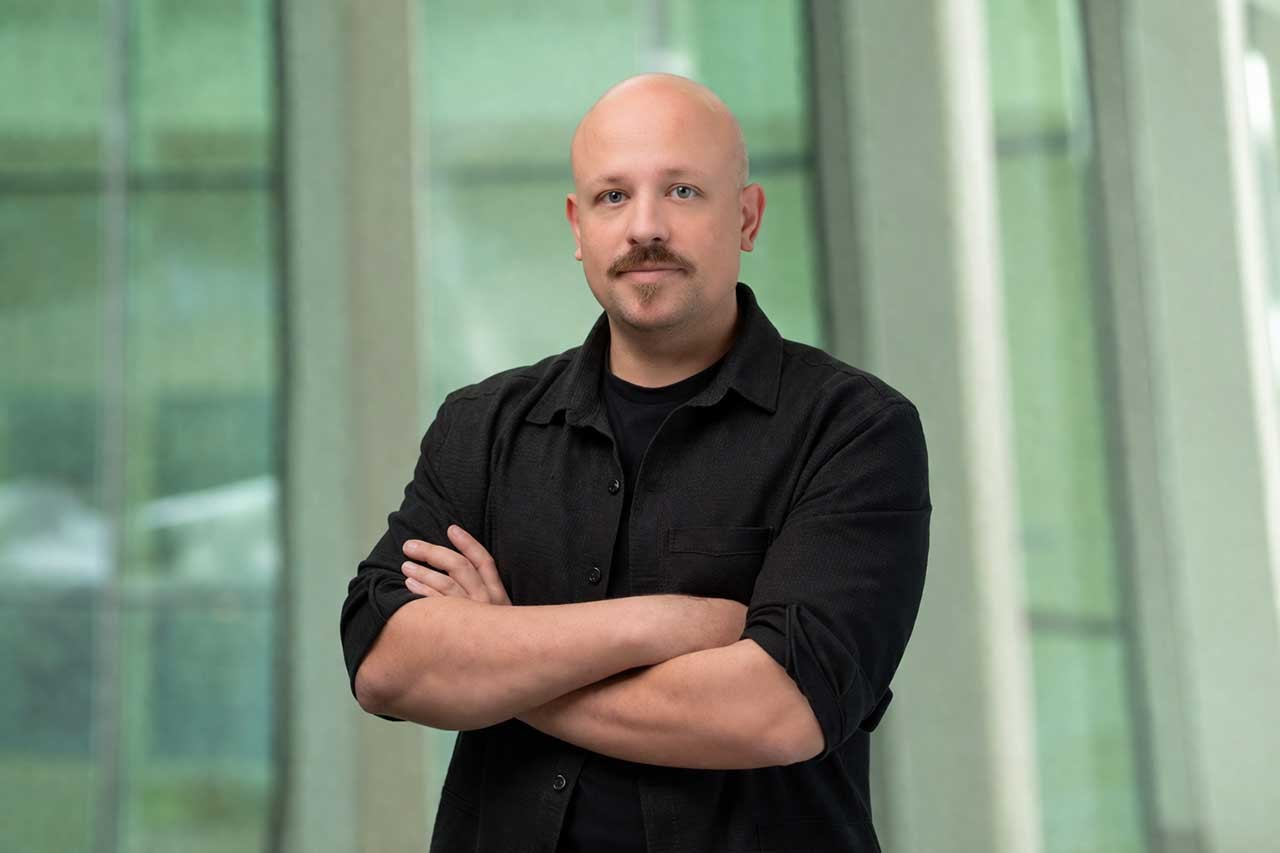
The Core Technology Platform (CTP) is home to machines that could transform how cities are built, from navigating construction sites and identifying problems to handling materials and carrying out physical tasks. Samuel Prieto, a research instrumentation scientist at NYU Abu Dhabi, is working on the technology behind them.
“Today, robots can move around a construction site, collect data, and tell us what’s happening,” he says. “The future is robots that can help build it, moving materials, assembling structures, and taking on physical work alongside people. That’s the leap we’re working towards.”
Constructing a career
Prieto grew up in Ciudad Real, central Spain, where his interest in robotics began at age nine. He spent his childhood taking apart electronics and household appliances to discover what was inside.
“I always knew what I wanted to do,” he says. “Whatever path I took, it had to lead me towards robotics.”
He studied industrial engineering at the University of Castilla-La Mancha, specializing in electronics and automation, before earning a PhD in robotics in 2019. His doctoral research explored how autonomous robots could reconstruct building interiors in 3D without human intervention.
That work led him into construction research, where robots could collect information about a building’s progress and provide engineers with more detailed data.
Prieto joined NYU Abu Dhabi in 2020 as a postdoctoral associate in the S.M.A.R.T. Construction Research Group, working with Professor Borja García de Soto. After five years, he became a research instrumentation scientist at CTP Kinesis, continuing his work with robotics and automation.
When robots start building
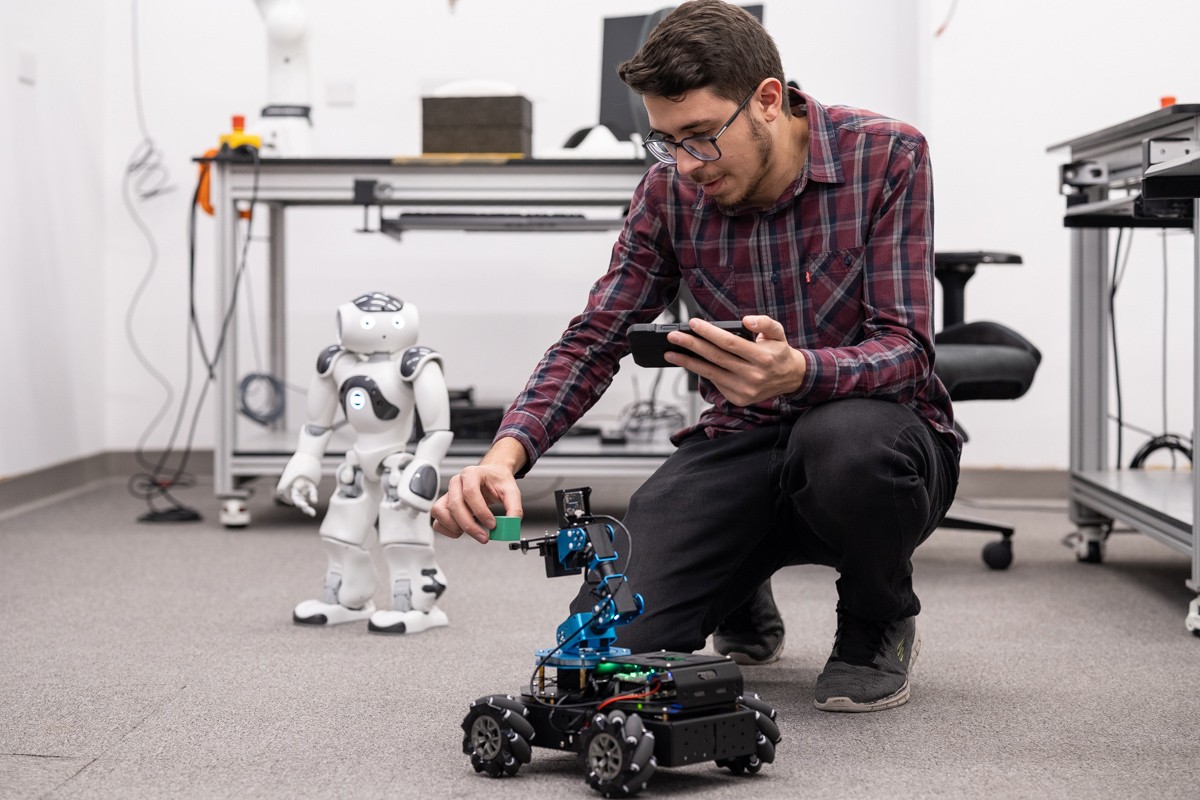
The CTP Kinesis lab contains almost 40 pieces of equipment, including robots, sensors, and robotic arms. Researchers can test how robots navigate, collect information, and interact with their surroundings, while an arena allows drones to fly in a controlled environment without GPS.
On construction sites, robots are already being used to navigate spaces and collect data. Equipped with cameras and sensors, they can capture images and measurements that AI can analyze, helping engineers track progress against plans and identify potential problems.
Workers and inspectors are still gathering much of that information manually. Automating the process could enable more frequent site monitoring while freeing qualified professionals to focus on findings and decision-making.
Prieto sees the bigger opportunity in giving these robots the ability to act instead of being mere observers. The eventual goal would be for them to be picking up materials, moving objects, and eventually carrying out parts of the construction process themselves.
“For a robot to actually build something, it has to interact with the world around it,” he says. “It has to pick things up, move them, and manipulate them. Ideally, we want them handling materials, assisting workers, or carrying out repetitive or difficult tasks.”
Bringing robots into homes
The opportunity reaches far beyond construction. The same ability to understand an environment and adapt to change could eventually bring robots into people’s homes.
A useful household robot could not simply be programmed for a single task in a single setting. It would need to understand what it was being asked to do and apply that knowledge in a new context.
Prieto believes embodied AI, which connects artificial intelligence with physical robots, could help machines develop that ability.

“If I teach this robot to load and unload my dishwasher, it should be able to do it in your dishwasher too,” he says. “That ability to generalize knowledge to a new environment is not there yet. That’s what robotics researchers are working towards right now.”
Large language models could provide part of the answer by giving robots access to much broader knowledge.
“Before, you had AI that was very good at one specific thing,” he says. “Now, with the large language models, you have general knowledge.”
The technology is also becoming more accessible, Prieto says. Robots that once cost more than USD 200,000 can now be bought for around USD 30,000, and robot vacuums have gone from novelty to familiar household appliances.
Prieto is cautious about predicting exactly what comes next, but he can imagine a future in which robots do far more than monitor a construction site or perform a single task at home. He estimated that more capable household robots could arrive within the next 10 to 15 years.
“One day, you could have robots building an entire building by themselves, or a robot at home that can cook, clean, load the dishwasher, and take care of all those everyday tasks,” he says. “To see that become part of everyday life within my lifetime would be extraordinary.”