From the labyrinth of pipes at Abu Dhabi’s desalination plants to the life-support machines in hospital ICUs, invisible membranes make precise separations that can mean the difference between seawater and drinking water, or between illness and recovery.
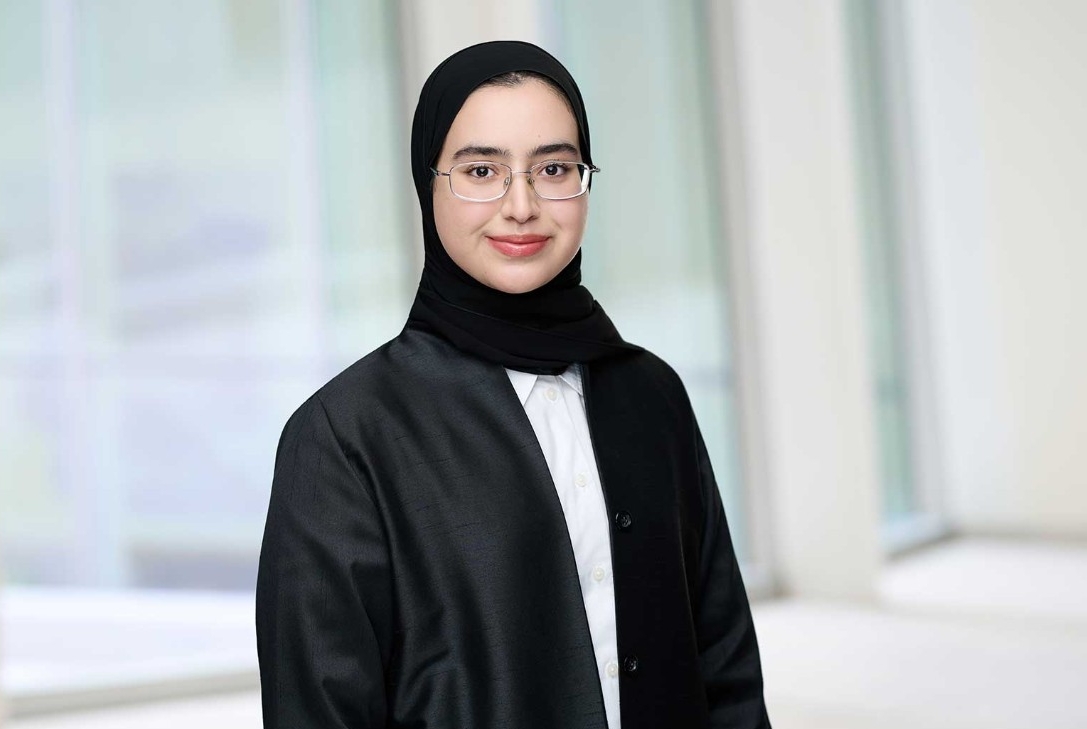
Emirati postdoctoral researcher Reham Al Nuaimi is applying her expertise in membrane science to another challenge: per- and polyfluoroalkyl substances (PFAS). PFAS is a family of highly durable chemicals that can persist in the environment and accumulate in water supplies, thus earning the nickname "forever chemicals."
Due to their resistance to heat, water, and grease, PFAS are used in many daily items, from non-stick frying pans, to dental floss and raincoats. They have no taste or smell, yet exposure to some PFAS has been associated with health concerns, including effects on the immune system, thyroid, and child development.
Working with NYU Abu Dhabi Assistant Professor Safiya Khalil Alhashmi’s lab through the Kawader program, Al Nuaimi is investigating materials that could capture PFAS and help break them down, rather than simply moving them into another waste stream.
“I don’t just want to study membranes,” she says. “I want to see this work translated into real technology that protects our resources.”
Finding her field
Al Nuaimi grew up in Abu Dhabi and during her master’s degree, became interested in desalination and the problems that can affect membrane performance, including fouling – the gradual build-up of minerals and other substances that can reduce efficiency.
Her PhD research focused on highly porous synthetic membranes with more uniform pore sizes, while also taking her into biomedical applications.
When an opportunity to join Alhashmi’s Khalil Lab through the Kawader program came, she took it. “The Kawader program gave me exactly what I needed after my PhD,” she explains.
“It is a bridge into a more independent role, and it gives me the platform to turn ideas from my thesis into something real.”

PFAS and active clean-up
“A membrane is a separation barrier,” she says. “If you think of a tea bag, it has pores that let the tea out but keep the leaves in.”
The engineering behind is considerably more complex. Membranes rely on microscopic pores to determine what passes through and what stays behind. The more consistent those pores are, the more predictable the separation can be.
“If you have large and small pores on the same surface, some particles you want to stop can slip through the bigger ones,” Al Nuaimi explains.
During her PhD, she worked on developing membranes with more uniform pores. She also studied membranes used in Extracorporeal Membrane Oxygenation (ECMO), a life-support machine that temporarily replaces the function of a patient's heart or lungs.
Those experiences now inform her work at NYUAD, where the challenge is not simply controlling what passes through a membrane, but targeting a particular contaminant.

Durability with a double-edged sword
PFAS are difficult to destroy because the chemical bonds that give them their durability also make them resistant to degradation.
“Separation alone is not enough,” Al Nuaimi says. The aim is not just to capture PFAS, and also to help break them down. The longer-term direction is to incorporate such materials into synthetic membranes, potentially allowing a single membrane to separate pollutants while also helping to degrade them.
She is currently exploring covalent organic frameworks (COFs), highly ordered crystalline materials whose structures contain tiny pores. By tailoring their chemistry and structure, researchers can investigate how these materials interact with particular molecules.
Scaling up and looking ahead
Al Nuaimi hopes to eventually take membrane technology beyond the laboratory.
During her PhD, her team scaled production from small laboratory samples to tens of meters of membrane, giving her an early understanding of the challenges involved in moving toward commercial applications.
Her ambition is ultimately to develop technologies that could serve desalination plants, industry and medical device manufacturers.
“One membrane cannot do everything,” she says. “But if you have a strong method, you can adapt it for many materials and many applications.”
For Al Nuaimi, the next stage is to turn that persistence into practical impact by creating technologies that solve problems in the UAE.
“The UAE has given me so many opportunities,” she says. “Now I want to turn this research into real solutions that give something back – cleaner water, better treatments, and new paths for the next generation of Emirati scientists.”
The NYUAD Kawader Research Assistantship Program is a unique, national capacity-building research fellowship program that allows outstanding graduates to gain experience in a cutting-edge academic research environment. This three-year, individually tailored, intensive program has two distinctive paths designed for Emirati graduates considering a graduate degree or a research career.