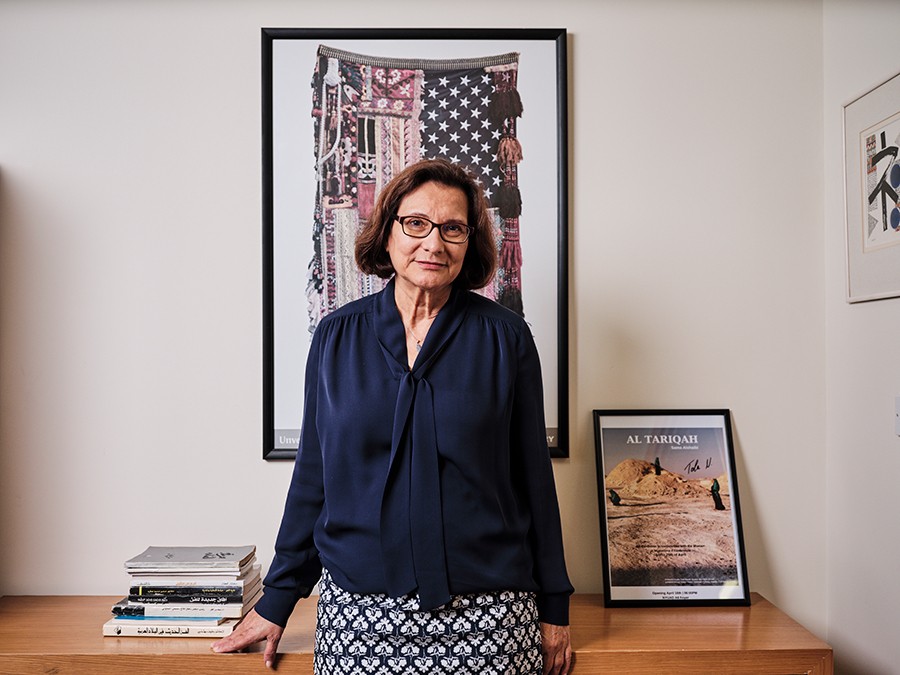
The lights glare, the cameras roll, and the crew sweeps into action, the Abu Dhabi side street transformed into a hazy, late-night film set. At the center of it all stands filmmaker Wendy Bednarz — focused, composed, and quietly attuned to every detail.
For more than a decade, the NYU Abu Dhabi professor has been drawn to stories that cross cultures and languages, shaping a body of work rooted in empathy and lived experience.
“I’ve always been in love with visual language,” she says. “Even when I was studying economics, even when I was working in fashion, film was always there.”
Bednarz grew up in Oregon, the daughter of a mother who adored cinema and insisted on sharing the classics. When she was barely eight years old, she picked up a Super 8 camera and began staging elaborate dramas with friends. It was a time before on-demand entertainment, when films appeared rarely on television, turning living rooms into communal theaters. “There was a ritual to it,” she says. “It made movies feel enchanted.”
After studying economics at Stephens College in Columbia, Missouri, she moved to New York and began working in fashion, first at Albert Nipon and later for Steven Sprouse in the old Andy Warhol Factory. But her desire to make films only intensified. Eventually, she took the leap, earning her MFA from NYU’s Tisch School of the Arts and stepping fully into filmmaking.
Global stories, local lenses
Bednarz’s career has taken her around the world, including time in Singapore teaching in NYU’s graduate film program. Her students, hailing from every corner of the globe, shaped her understanding of storytelling across cultures. “The transnational, multinational narratives reflect my own life,” she says. “Every chance I get, I travel. It’s part of the fabric of who I am.”
Now Program Head of Film and New Media at NYUAD, Bednarz continues to balance filmmaking with teaching. Her work has screened internationally at MoMA, the Montreal World Film Festival, and the Venice Film Festival, and has earned honors including the Cine Golden Eagle, the Independent Film Award, and the Sundance Winfemme. But for her, the most meaningful recognition comes from audiences. “When someone says a film touched them or helped them see the world differently — that’s what stays with me,” she says.
Her narrative feature Yellow Bus, based on a real-life incident, was born from a visceral emotional response. “I couldn’t imagine putting my children on a school bus and only one returning home,” she says. She chose to tell the story through the eyes of a mother, guided by empathy and a desire to explore the human dimensions of grief and community. “When a story hits you in your heart and won’t let go,” she says, “that’s when you know you have to tell it.”

Her documentary Burning Money, filmed in Singapore, explores the centuries-old practice of burning paper replicas, including everything from shirts to mobile phones as offerings to loved ones in the afterlife. “I became fascinated,” she says. “It’s a beautiful ritual of reverence.” What began as curiosity in a wet market became a deeply researched, culturally grounded film that reflects her approach to storytelling: attentive, respectful, and human-centered.
Bednarz is thoughtful about directing stories rooted in cultures beyond her own. “It’s a delicate dance,” she says. “If you’re telling a story outside your culture, you must do the research, be reflective about your place in it, and surround yourself with collaborators who live it. It has to come from respect.”
From film to faculty
Her path into teaching came unexpectedly. After a back injury interrupted her cinematography work, she accepted an invitation to teach at Tisch in New York. What she discovered was a new passion. “I fell in love with the electricity in the classroom,” she says. “The exchange of ideas, the way students push you — it fuels me.”
Abu Dhabi, where she has now taught for 11 years, continues to inspire her. “This place vibrates with possibility,” she says. “If you have an idea, the opportunities are here. People are willing to try new things, to break barriers.”
Looking ahead, Bednarz is continuing to develop stories that cross borders through narratives that bridge worlds rather than divide them. Her next film moves between the US and Nigeria, exploring identity, truth, and reinvention. And after two intense, emotionally heavy projects, she hints that she is working on something lighter. “My next film is a comedy,” she says. “Still meaningful, still human, but something that lets people breathe.”
At the heart of all her work is a simple aim. “I want to make films that touch people,” she says. “That opens a window onto a life, culture, or experience they might not otherwise encounter. If a story can do that, even for one person, then it’s worthwhile.”