The farmer arrives at the end of the season with gratitude in his hands: a small goat, a gift for the economist who helped him plant where his land would have lain barren.
In villages across Ghana where government services have yet to reach, Yaw Nyarko has spent four years proving that economic theory can change lives when applied with precision.
Some farmers have doubled their maize harvests. Others speak of aluminum roofs replacing straw, keeping out the insects that once crawled through the thatch at night. “Those are the real joys,” Nyarko says. “Those are the places where you see things really happening.”
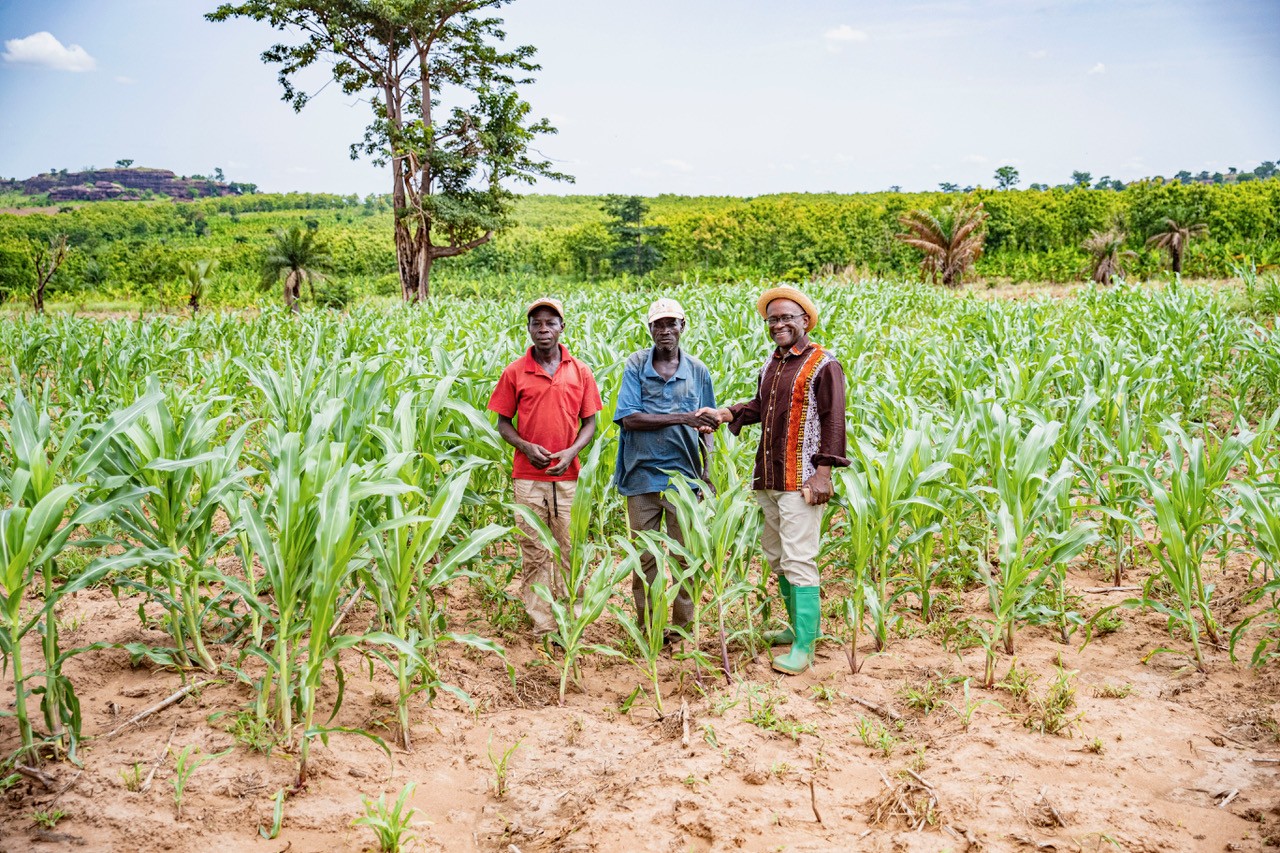
Nyarko, Professor of Economics at NYU Abu Dhabi and founding director of NYU Africa House and the Center for Technology, Economics, and Development (CTED), operates at the intersection of theoretical economics and ground-level impact. His work tackles a problem that has constrained African agriculture for generations: banks won't lend to smallholder farmers because they're too modest, too dispersed, and too difficult to monitor. His innovation lies in using technology to change that.
From village life to a global mission
Growing up in Kumawu, Ghana, in a society he describes as “culturally rich but materially poor,” Nyarko saw what needed to change from an early age.
“I’d look around at the rest of the world, and ask myself, how come my country, my people, are not as rich as everybody else?” Nyarko says, reflecting on the question that went on to shape his career.
“If there's a burning passion, it's bridging that gap and making sure that we are as economically successful as any other people in the world,” he adds. “That means understanding why the difference exists and figuring out how to address it.”
That drive led him from the University of Ghana, where he studied economics and mathematics, to Cornell University for his PhD in economics, then to Brown University for his first academic position. He joined NYU in the US in the early 1990s, building a career as both a theoretical economist and a specialist in development economics, the field dedicated to understanding how poorer nations can grow.
As NYU’s Vice Provost in the early 2000s, Nyarko's influence extended globally. As the university began exploring opportunities in the Middle East, he flew over Saadiyat Island in a helicopter, looking down at empty desert as gazelles jumped across the sand.
“That was the only thing on all of Saadiyat Island,” he recalls. “I was one of the first people at NYU Abu Dhabi, and the campus grew from there.” In 2010, he joined as faculty and has taught at the University ever since.
Technology in the field
Nyarko's recent work in agricultural economics came from recognizing that technology could solve what traditional banking could not. Using blockchain and mobile phone apps, Nyarko created a system of virtual currency that farmers receive and can only spend with verified suppliers of fertilizer, labor, and warehousing services.
Each transaction creates a digital record, building the credit history and accountability that banks require. It's an elegant economic solution that reduces information costs, increases transparency, and allows the market to function where it previously failed.

The work has taken him far beyond academia. The Ghana government gave him a 1,000-metric-ton warehouse to manage, complete with rodents, break-ins, and security concerns. “I'm operating a warehouse, and I'm an economics professor,” he says. “It's not what you’d expect from a typical economist writing theoretical papers.”
Yet this is precisely where economic theory meets reality. His blockchain system addresses the capital constraint that has always limited these farmers. “They don't have money to start,” he explains. “Banks don't give them money because they're too small and too hard to find and too hard to secure their loans.”


The virtual currency system creates a trackable framework where farmers can access resources they otherwise couldn't afford, building the transparency that traditional banking requires.
“It's very fulfilling,” he says. “You feel like you're doing something real. It's not just writing mathematical equations on a piece of paper.”
Better harvests ahead
Now, Nyarko is bringing artificial intelligence into agriculture with a USD 3.5 million Gates Foundation grant. His team is developing agricultural large language models that farmers can consult about pests or weather patterns, applying the latest technology to age-old challenges.
It's the same spirit that drove him from his hometown decades ago, and continues to fuel his ambitions in Africa and beyond.
“It could be revolutionary,” he says. “Africa is not just what you see on the news. It's not just malnutrition and poverty; it's a billion people, and there's a lot of great things going on there.”
“The culture is great. The art is great. We've got our pride, we've got our traditions, and we love them,” he adds. “We're just trying to get a little bit richer. That's all.”