
Sunlight filters through stained-glass windows as hymn books are passed along a crowded pew in a church in southwestern Nigeria. A six-year-old girl reaches for her own copy, eager to join the music around her. Her father, a university professor, flips to the first song, ready to show her the words. She cannot read a single line. Her parents exchange a look as realization dawns.
Suddenly, holidays become lessons. The family study transforms into a classroom. Her mother wipes the blackboard clean each morning and holds up index cards each afternoon. For a young Onoso Imoagene, what begins as a stumble becomes a spark.
“That was the end of carefree summers,” she says with a laugh. Her place as the youngest of five children was suddenly impossible to overlook. She added teasingly, “By the time my parents were having me, they were all tired out. I was the unattended weed in a garden. Here I am now, so it must have worked.”
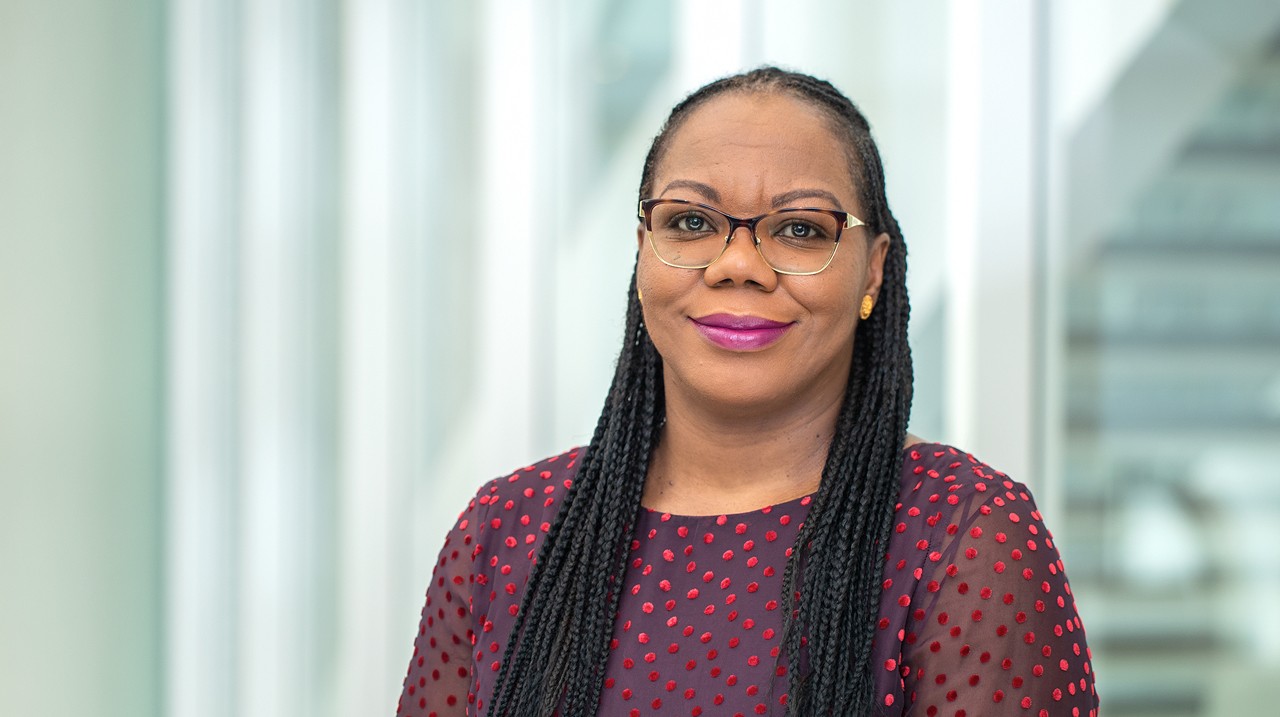
Today, Imoagene is an Associate Professor of Social Research and Public Policy at NYU Abu Dhabi and a Global Network Associate Professor of Sociology at NYU New York. Her journey to Abu Dhabi spans three continents, two influential books, and a research agenda that challenges some of the most entrenched narratives about migration, race, and belonging.
Her father, a professor of sociology at the University of Ibadan and an expert in social stratification, also shaped her path. When she resisted the family’s suggestions of medicine, veterinary science, or law, he offered a simple alternative. Sociology, he told her, would let her do anything. She agreed and graduated top of her class, becoming one of the very few students in the university’s history to earn a first-class degree in sociology.
“My parents' friends were furious that I was allowed to choose sociology over law,” she recalls. “Yet that choice opened every door that followed.”
Those doors included working for Accenture in Lagos, a master’s degree in Modern Society and Global Transformations at the University of Cambridge, a diversity visa that took her to the US, and acceptance into Harvard University’s prestigious doctoral program in sociology.
Arriving in Cambridge marked a turning point. Initially, she began studying gender inequality in Nigerian workplaces, but her experience as a minority in England stirred an intellectual shift. As debates around immigration and identity crackled through campus, her focus evolved. She wanted to understand how minorities forge a sense of belonging in societies where they remain visibly outnumbered.
The US offered the right intellectual community. At Harvard, she proposed studying the children of Nigerian immigrants. Recognizing that the histories and trajectories of different African diasporas are not interchangeable, she sought to illuminate the distinct experiences of Nigerians. “For historical and contemporary reasons, these are different groups,” she says.
That perspective shaped her first book, Beyond Expectations. It is the first comparative study of adult second-generation Africans in both the US and the UK, reshaping academic conversations about the diversity of Black immigrant experiences, and challenging assumptions that treat Black communities as culturally monolithic.
“I wanted to show that ethnicity matters among Black populations,” she explains. “There is no single Black culture. There are many voices and many trajectories.”
Her second book, Structured Luck, examines the impact of the US diversity visa lottery on West African migrants. The program offers a pathway to new possibilities, yet its timing can sometimes disrupt educational or professional trajectories. By helping to build a more informed understanding, she hopes her research can inform policies that support long-term success for those who make these journeys.
“Immigrants are self-selected,” she says. “They have drive. They have potential. Policies must not waste that potential.”
Imoagene’s current projects continue this focus on lives shaped by borders and bias. One involves new data on second-generation Africans in the US and their views on identity, opportunity, and equality. Another examines African and Chinese migrations in both directions, with a growing focus on children born to one African and one Chinese parent. They are testing the limits of citizenship frameworks never designed with their futures in mind, she notes.
She moved to NYUAD in 2021, shortly after receiving a prestigious fellowship at the Russell Sage Foundation in New York. “I love the students here,” she says. “They are strong, curious, and deeply invested in their work. The research support is extraordinary.”
Her story remains shaped by that scene in church, by parents who refused to let potential slip away, and by her own willingness to rebuild home wherever opportunity led.
What keeps her moving forward is simple. “I study migration because I live migration,” she says. “I know what belonging feels like and what exclusion feels like. I hope that my work will help societies choose belonging.”