
Amyloidogenic Protein Interactors
Nanobodies
Camels, dromedaries, llamas, alpacas (but also sharks) possess IgG’s formed by heavy chains only.


The variable domain of heavy-chain antibodies, VHH, is expressed to be used as nanobody. A specific nanobody, Nb24, prevents in vitro fibrillogenesis of D76N β2-m, a highly amyloidogenic protein, and alters its tissue distribution in vivo.
NMR Epitope Mapping: from the spectrum perturbation it is possible to localize the binding region.

NMR spectrum of D76N β2-m, free and bound to Nb24 nanobody
Nanoparticles Disrupt Early Protein Oligomerization and Inhibit Amyloid Fibrillogenesis
Citrate-stabilized gold nanoparticles (Cit-AuNPs) were found to effectively inhibit the fibrillogenesis of highly amyloidogenic proteins such as the D76N variant of b2-microglobulin (b2m), contrary to earlier reports on nanoparticles promoting aggregation.
By NMR spectroscopy, the interaction between b2m and Cit-AuNPs was mapped. A "soft corona" fast-exchange regime was observed where the protein maintains its native structure while transiently contacting the nanoparticle surface. The NMR data showed unevenly distributed signal attenuation across the protein backbone, specifically identifying the N-terminal segment and the BC and DE loops as preferential interaction sites. Based on the NMR results, molecular dynamics modeling revealed that Cit-AuNPs hinder fibril formation at the earliest stages of aggregation, precisely by splitting and disassembling protein dimers, which prevents the subsequent recruitment and formation of protofibrils.
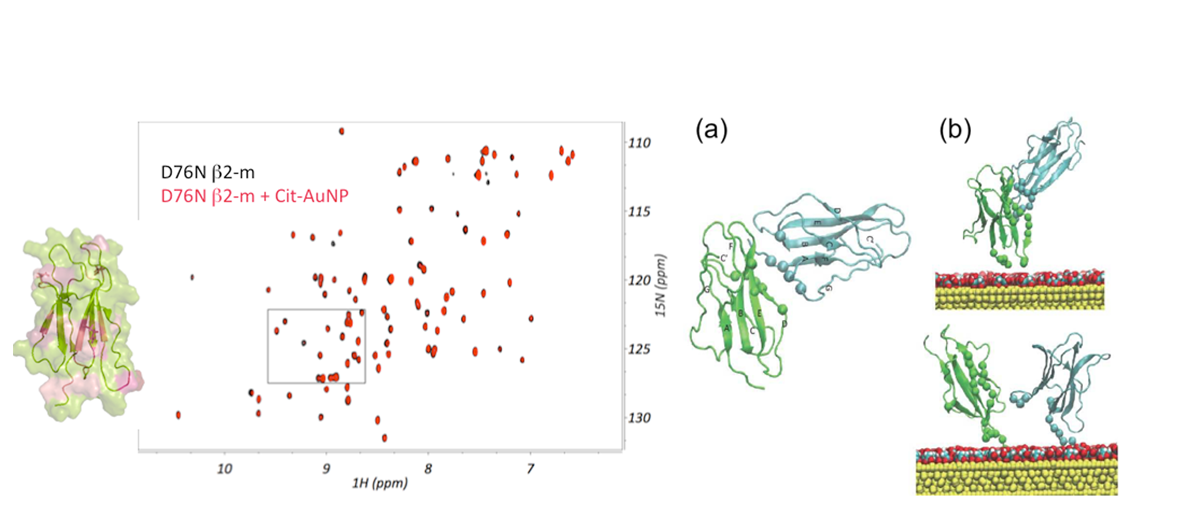
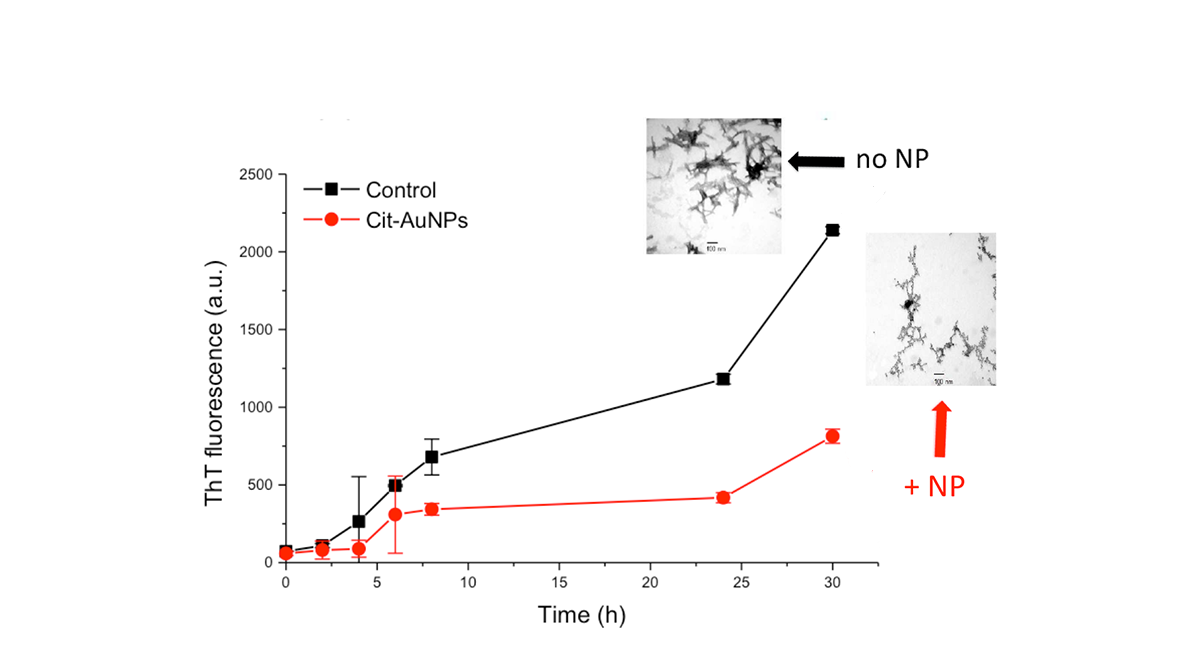
The interaction with Cit-AuNPs prevents fibrillogenesis.
Trefoil Knot Inhibits Protein Amyloidogenesis
A groundbreaking approach to inhibiting protein amyloidogenesis was explored by utilizing topologically non-trivial metal-organic assemblies as synthetic molecular chaperones. By targeting b2-microglobulin (b2m) and its aggressive D76N mutant, two proteins responsible for severe amyloidotic pathologies, the study demonstrated that zinc-templated structures like catenane, trefoil knot, and Borromean ring can effectively suppress the formation of toxic fibrils. Those synthetic assemblies operate through labile supramolecular interactions occurring under fast-exchange regime that interfere with protein-protein pairing without disrupting the protein’s native structure. Experimental evidence using NMR spectroscopy, molecular dynamics and atomic force microscopy confirmed that the rigid metal-organic structures inhibit fibrillogenesis in vitro. Furthermore, in vivo testing in a Caenorhabditis elegans disease model showed that the administration of trefoil knot complexes significantly restores animal motility, proving the bioactivity and therapeutic potential of those non-trivial molecular architectures in treating misfolding diseases.
