


Humanity has begun a new phase of lunar exploration. Through the NASA Artemis Program, astronauts are preparing to travel beyond Earth’s protective magnetic shield and return to the Moon for the first time in more than half a century.
The stakes are rising rapidly. Following the successful completion of Artemis II this month, the next phases will push human spaceflight further than it has gone in decades, testing commercial landing systems in Earth orbit before returning astronauts to the lunar surface. In 2028, plans call for the construction of a permanent Moon base, supported by annual missions designed to establish a sustained human presence, laying the groundwork for eventual journeys to Mars.
The program’s most recent historic milestone, Artemis II, marked the first crewed journey beyond low Earth orbit in decades. The astronauts flew around the Moon and travelled further from Earth than any humans since the Apollo era, testing the Orion spacecraft’s ability to support human life in deep space.
Yet one of the greatest challenges facing astronauts on these missions is largely invisible. Radiation.

At NYU Abu Dhabi Center for Astrophysics and Space Science, astrophysicists are studying how cosmic radiation and solar storms interact with planetary environments, research that is increasingly relevant as humans prepare to spend extended periods beyond Earth’s natural protective shield.
Beyond Earth’s protection
Life on Earth is sheltered by two natural defenses: a strong magnetic field and a thick atmosphere. Together they deflect or absorb most high-energy particles arriving from space.
But astronauts traveling to the Moon leave that protection behind.

On the lunar surface there is no atmosphere and no global magnetic field. Astronauts are directly exposed to galactic cosmic rays, high-energy particles that originate from distant supernova explosions and travel through space at nearly the speed of light.
Radiation levels on the Moon are dramatically higher than on Earth. Estimates suggest astronauts on the lunar surface could experience radiation doses up to 200 times higher than the natural background radiation we experience on our planet.
Understanding this environment is essential for designing future lunar missions and protecting astronauts during long stays on the surface.
“Once you leave Earth’s atmosphere and magnetosphere, the radiation environment changes dramatically,” Atri explains. “Astronauts are exposed to energetic particles that can penetrate spacecraft, habitats, and even human tissue.”
When the Sun erupts
Cosmic rays are only part of the challenge.
The Sun itself can produce sudden bursts of radiation known as solar energetic particle events. These occur during solar flares or coronal mass ejections and can release enormous quantities of high-energy particles into space.
Such events are difficult to predict and can vary enormously in intensity.
“Most solar particle events produce relatively modest radiation doses,” Atri says. “But extreme events can deliver very large doses in a short time.”
History provides a sobering example. In August 1972, between the Apollo 16 and Apollo 17 missions, the Sun produced one of the most powerful solar particle events ever recorded. If astronauts had been traveling between Earth and the Moon during that period without adequate protection, the radiation exposure could have been fatal.
For shorter missions like Artemis II, which lasted roughly ten days, cumulative radiation exposure remains manageable. The greater concern is the possibility of an unexpected solar storm during a mission, when astronauts have limited shielding and nowhere to hide from the incoming radiation.

Designing safer lunar missions
Addressing these risks requires a detailed understanding of how radiation interacts with spacecraft materials, planetary surfaces, and the human body.
At NYU Abu Dhabi, Dimitra Atri and his colleagues use advanced computational tools, including GEANT4, the same particle-physics simulation framework used at CERN, to model how cosmic rays and solar particles interact with different environments.
These simulations allow researchers to estimate how much radiation astronauts might receive during future missions and evaluate how various shielding materials could reduce that exposure.
Standard aluminium spacecraft shielding can reduce radiation levels by roughly 25 to 40 percent. While helpful, that level of protection may not be sufficient during extreme solar storms, prompting scientists to explore alternative materials and shielding strategies.
By understanding these interactions in detail, researchers can help engineers design safer spacecraft and habitats for the next generation of lunar explorers.

The Moon as a gateway to Mars
For planetary scientists, the Moon is more than a destination. It is a testing ground for the technologies and scientific knowledge needed for future missions deeper into the solar system.
Radiation environments on the Moon provide a valuable opportunity to study how energetic particles interact with planetary surfaces and potential resources.
“Everything we learn about radiation on the Moon will help inform the design of missions to Mars,”
Long-duration missions to the Red Planet will expose astronauts to even greater radiation challenges, making research conducted today essential for planning those journeys.
Simulating space on Earth
Understanding the Moon also requires recreating its harsh conditions on Earth.
At NYU Abu Dhabi, researchers have developed specialized facilities that simulate extraterrestrial environments. Among them is the Space and Planetary Environment simulAtoR (SPEAR), a planetary simulation chamber capable of reproducing the extreme vacuum, temperature swings, and ultraviolet radiation conditions found on the lunar surface.

Using such facilities, scientists can test materials, instruments, and scientific experiments before they are deployed in space.
The research team, including Research Assistant Vignesh Krishnamoorthy has also developed the Emirates Lunar Simulant, a high-fidelity replica of lunar soil designed to mimic the mineralogical properties of real lunar regolith (a layer of loose material, including dust, soil, and broken rock formed through weathering, erosion, and impact processes). The simulant allows researchers to study how equipment and structures might interact with lunar dust, a notoriously abrasive and electrostatically charged material.
Together with a planned lunar yard test facility that will replicate the terrain of the Moon’s surface, these tools provide state-of-the-art, end-to-end capabilities, from the molecular scale to the mission scale, for testing lunar technologies and scientific instruments before they leave Earth.
A Growing space science ecosystem
This research is unfolding within a rapidly expanding space science ecosystem in the United Arab Emirates. In recent years, the country has demonstrated its capabilities through a series of landmark missions, momentum now reinforced by adoption of the UAE National Space Strategy 2031 - an ambitious roadmap to strengthen its position in the global space sector.
The Emirates Mars Mission “Hope Probe” is delivering unprecedented insights into the Martian atmosphere, enabled by a unique orbit that allows scientists to observe the planet’s weather systems on a global scale. Meanwhile, the Rashid Rover program is preparing for lunar exploration. Looking further ahead, the UAE’s asteroid belt mission, scheduled for launch in 2028, will visit seven asteroids, an unprecedented journey for any space agency.
Researchers at NYU Abu Dhabi are contributing to these efforts in a variety of ways through fundamental science, instrument development, and planetary environment research, conducting radiation modeling, surface geochemistry and instrument development that these missions need.
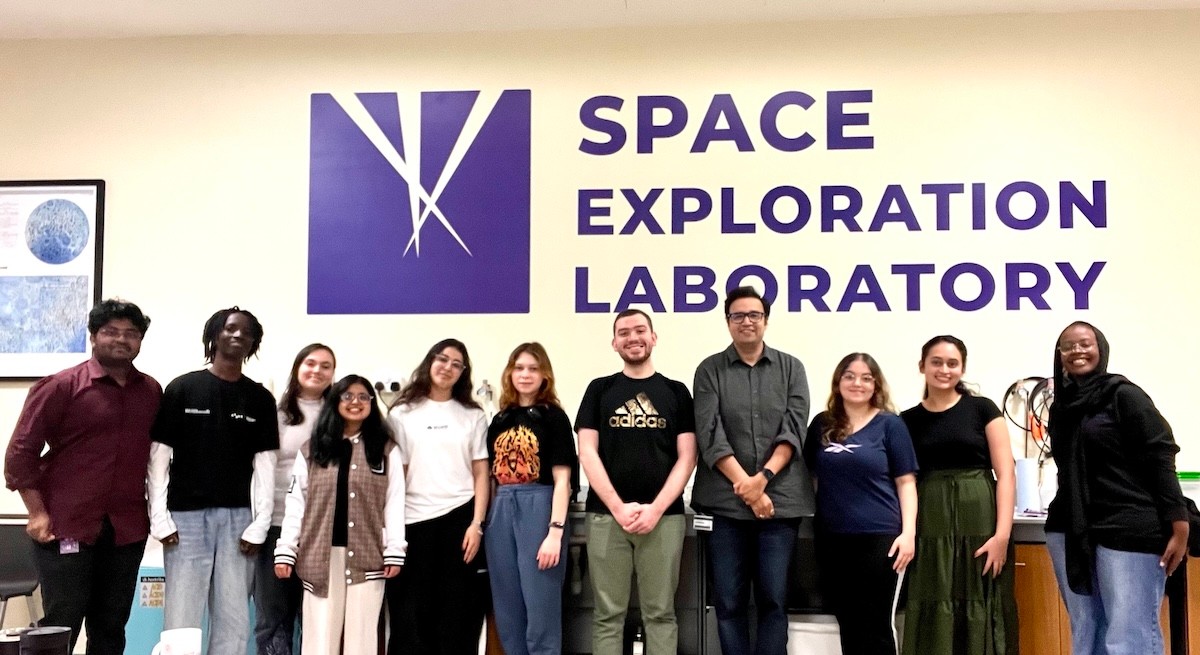
Atri leads several experiments on upcoming lunar missions designed to study magnetic properties of lunar soil, electrostatic behaviour of lunar dust, and the degradation of organic materials on the lunar surface.
This work illustrates how planetary science, engineering, and space exploration are increasingly interconnected.
“Understanding radiation, dust behaviour, and volatile resources on the Moon are not separate problems,” Atri says. “They are interconnected challenges that any sustained human presence must address.”
As humanity prepares to return to the Moon, and eventually travel onward to Mars, interdisciplinary research conducted in laboratories around the world, including at NYU Abu Dhabi, will play a crucial role in making those journeys possible.
And while astronauts may capture the world’s imagination as they explore new worlds, the science that protects them from the invisible dangers of space is already being built here on Earth.