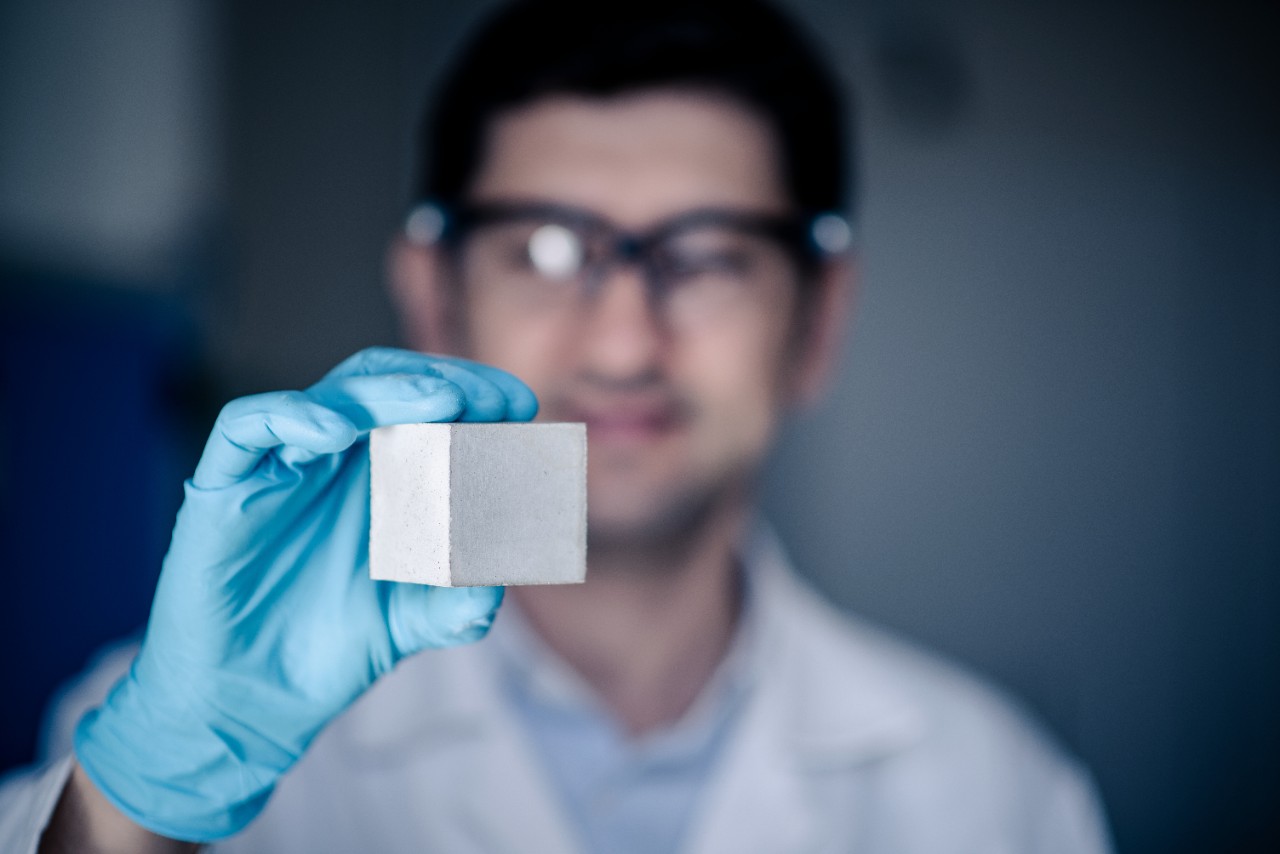

As the world searches for ways to reduce carbon emissions and create more sustainable infrastructure, Associate Professor of Civil Engineering Kemal Celik is pioneering new construction materials that transform industrial waste into climate solutions.
Throughout his career, Celik has been guided by the idea that “we do not inherit the Earth from our ancestors; we borrow it from our children.” While many see this as a proverb about environmental responsibility, Celik treats it as a practical design brief.
“If we're borrowing this world from future generations,” he says, “then we have an obligation to return it in better condition than we received it.”
That philosophy underpins the work taking place in the AMBER Lab, where lab director Celik and his team are rethinking one of humanity's oldest and most essential building materials.
Their goal is to transform waste into construction materials that reduce emissions, store carbon, and help cities become part of the climate solution, while positioning Abu Dhabi as a global testbed for the future of sustainable building.
Rethinking the world's most used material
Concrete is so commonplace that it often goes unnoticed. It forms the buildings we live in, the roads we travel on and the infrastructure that supports modern life. Yet cement, the binding ingredient in concrete, accounts for around 8% of global carbon dioxide emissions.
If cement were a country, it would be the third-largest emitter in the world.
As cities continue to grow, demand for housing and infrastructure will only increase. The challenge is no longer whether we build, but how.
For Celik, the answer lies in replacing the traditional linear model of construction — extract, manufacture, use and discard — with a circular one, where industrial waste becomes the raw material for the next generation of buildings.
That realization began during his doctoral research. Exploring alternatives to conventional cement, he discovered that even modest improvements in cement chemistry, multiplied across the billions of tonnes produced each year, could significantly reduce global emissions.
“That was the moment I realized materials science is climate action, at scale,” he adds.

Today, his research focuses on developing low-carbon construction materials that reduce emissions during production, improve building performance, and extend the lifespan of infrastructure.
From laboratory to construction site
Inside the AMBER Lab, researchers transform waste streams into new building materials, testing their strength, durability, and carbon impact before scaling up production.
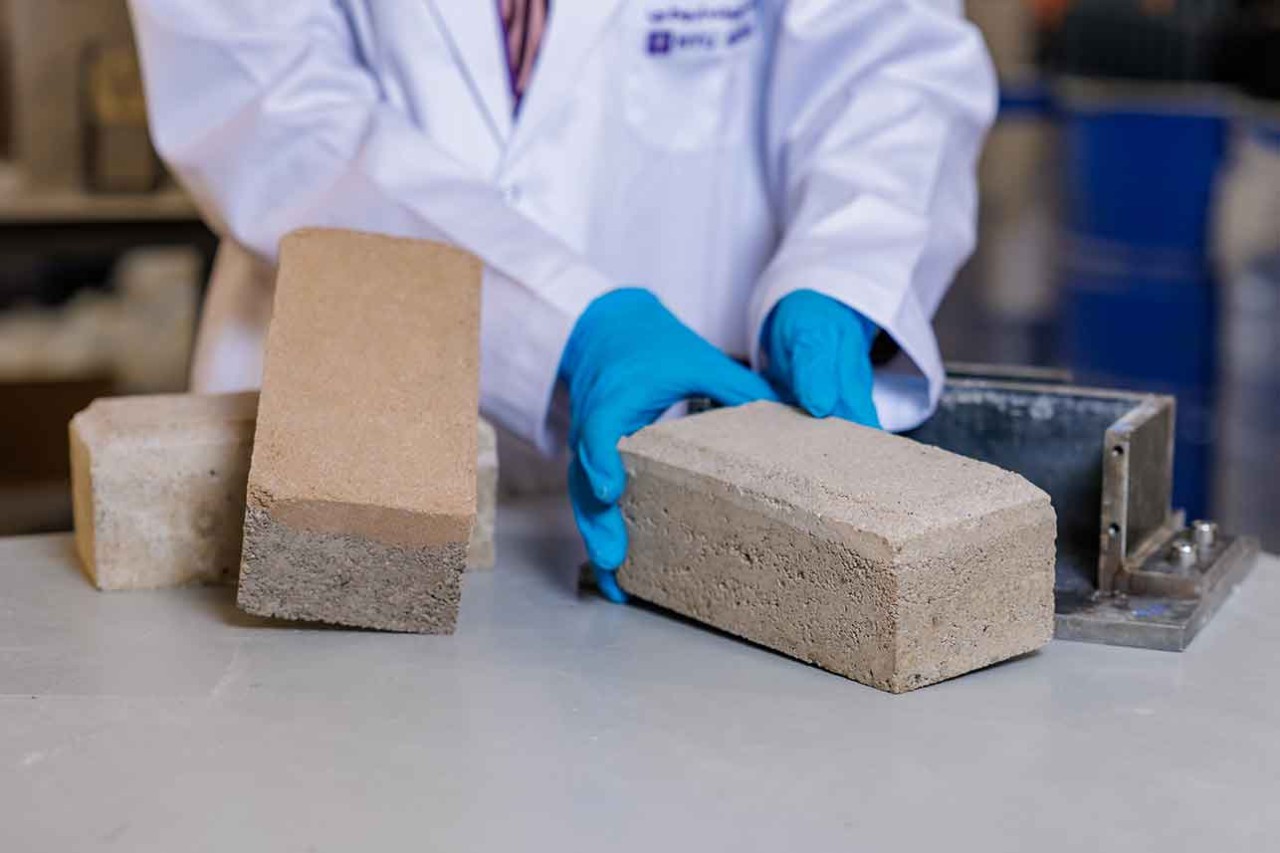
One project, SaltCrete, uses desalination reject brine, the concentrated saltwater left over when freshwater is produced, to make a cement binder.
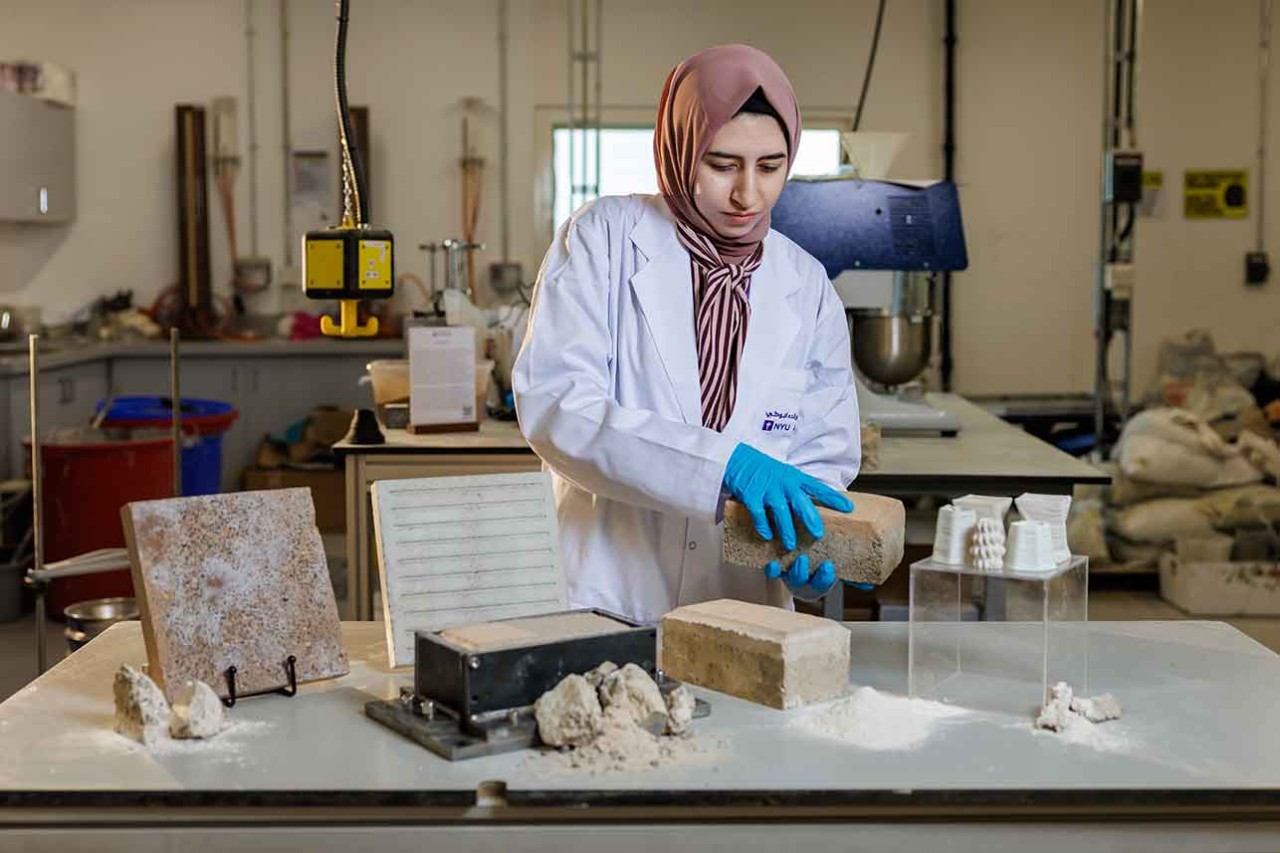
The team has now processed several hundred liters of brine at pilot scale and is working with a UAE block manufacturer to prepare its first demonstration pieces: pavers cured using carbon dioxide. A larger pilot installation is planned for 2027.
Celik also reports growing interest from local utilities, industrial companies, and investors in turning brine into construction materials.
Alongside this progress, the researchers have shown that seawater can replace freshwater in producing magnesium-based concrete. The brine process can also yield sodium hydroxide, hydrochloric acid, freshwater, and a low-salinity stream that Celik says can be safely returned to the sea.
In the future, concrete for homes or schools could be made from materials currently considered waste, potentially absorbing carbon dioxide instead of emitting it.
“The way a tree does as it grows,” Celik says. “Same strength, same reliability, opposite climate impact.”
Turning that vision into reality requires expertise that crosses traditional academic boundaries. Chemists, materials scientists, civil engineers, and manufacturing specialists work together in the AMBER Lab to ensure promising discoveries can become practical technologies adopted by industry. “The most interesting breakthroughs happen where disciplines overlap,” Celik says.
Materials themselves are becoming intelligent. The AMBER Lab is developing self-sensing materials that act as their own structural health monitors, reporting stress and damage from inside the concrete, and self-healing materials that repair their own microcracks before they grow; advances that could transform durability, safety and maintenance. With AI-driven analysis, the streams of data these materials generate become actionable: deterioration could be predicted before it happens, and new material formulations could be discovered in months rather than decades.
What excites Celik most, though, is the convergence of these advances. He imagines a bridge printed robotically from waste-derived, CO₂-cured material that stores carbon, senses its own condition throughout its life, heals its own damage, and feeds its data into models that design the next generation better.
“Every element of that picture exists in a laboratory today,” he says. “That is no longer science fiction; it is an engineering timeline.”
The cities of tomorrow
If the AMBER Lab succeeds, future cities may not look dramatically different from today's.
The real transformation will lie beneath the surface. Buildings will be made from materials once considered waste. Infrastructure will help store carbon rather than generate it. Construction will become part of a circular economy in which resources are reused instead of discarded.
For Abu Dhabi, the opportunity is particularly significant. The emirate brings together the scientific capability, environmental challenges, and ambition needed to develop and scale these technologies.
SaltCrete is set to be showcased at the Water Innovation Journey during the Water Summit at Abu Dhabi Water and Power Week, at the invitation of NYUAD’s partners at TAQA and the Abu Dhabi Department of Energy. The team is also developing a concept piece for the Ideas Abu Dhabi Pavilion at the UN Water Conference.
“If we prove these technologies here first, the UAE will not just be importing sustainable construction; it will be exporting it to the world,” Celik says. “That is the future I would like the AMBER Lab to help build.”