
Galaxy Formation Group
In the last few years, a standard model of cosmology has emerged, called the LCDM model. Ordinary luminous matter (baryons) makes up only a small fraction (about 4 percent) of the total mass density. The remaining part of the universe is dark and made up of two different ingredients: Dark Matter and Dark Energy.
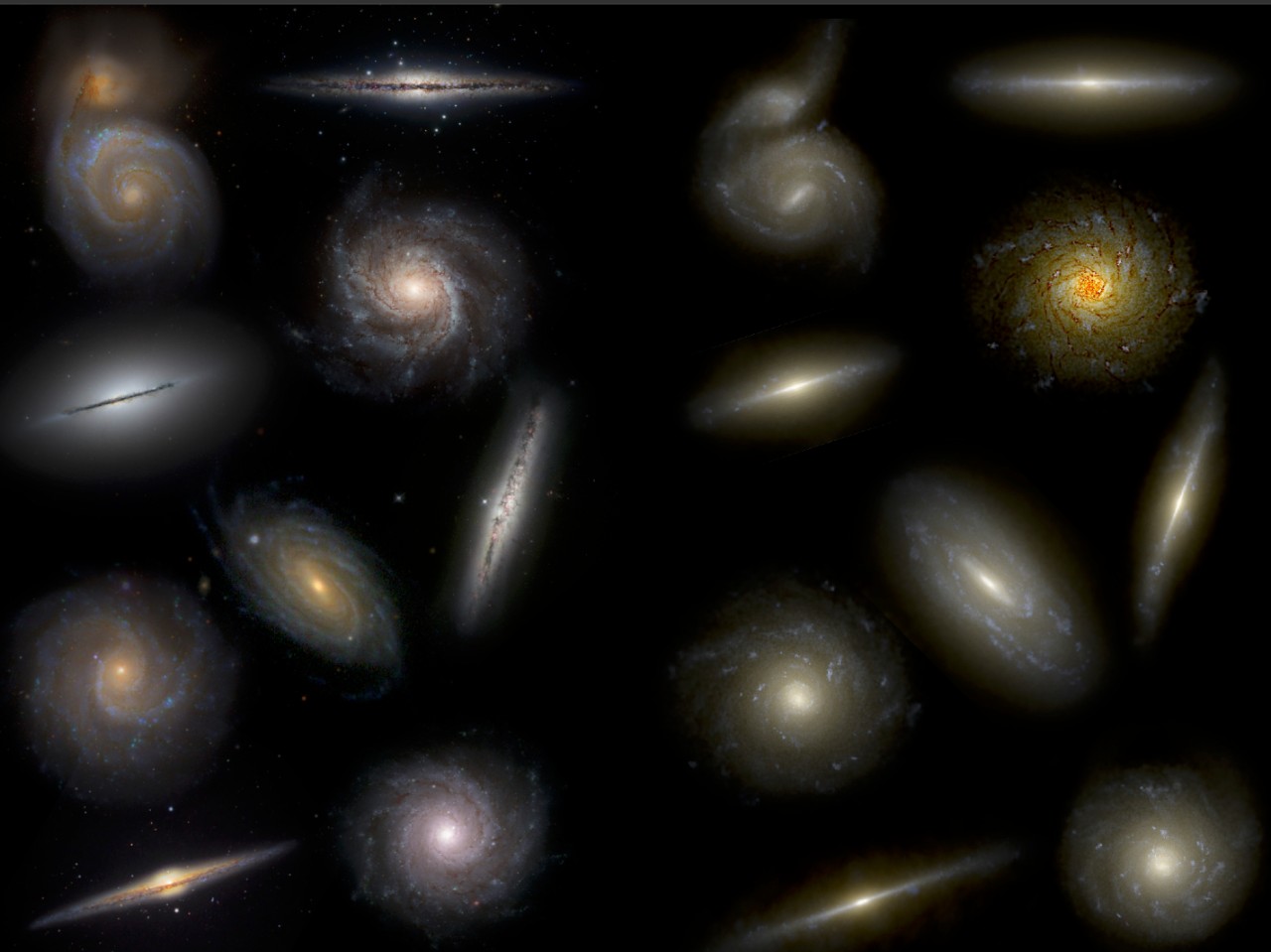

The theory of cold dark matter (CDM) provides now a successful framework for understanding structure formation in the universe. In a universe dominated by CDM and a cosmological constant galaxy formation and evolution is a complex combination of hierarchical clustering, gas dissipation, merging events and secular evolution
NYU Abu Dhabi's Galaxy Formation Group uses state of the art numerical cosmological simulations to study galaxy formation and evolution during cosmic times with the aim to use the visible part of the Universe to unveil its dark side.
Research Fields
- Hydro-Dynamical Cosmological Simulations of Galaxy Formation
- Nbody and Hydro Simulations of Non-Standard Dark Energy Models
- Nbody and Hydro Simulations of Different Dark Matter Models (WDM, WCDM, etc.)
- Galaxy - Dark Matter Connection
- Numerical Modeling of Feedback Processes
- Gravitational Lensing
- Simulations of Galaxy Mergers and Galactic Dynamics
Research Team
| Andrea Valerio Macciò | Professor of Physics |
| Moe Abbas | Research Associate |
| Moaz Abdelmaguid | PhD student |
| Leen Alrawas | PhD student |
| Shubhan Bhatia | Capstone student |
| Daniel Bramich | Research Scientist |
| Carlo Cannarozzo | Postdoctoral Associate |
| Changhyun Cho | PhD student |
| Mitale Damle | Postdoctoral Associate |
| Benjamin Davis | Research Associate |
| Honey Htun | Capstone student |
| Zehao Jin | PhD student |
| Fazeel Khan | Research Associate |
| Saakshi More | Capstone student |
| Ahmad Nemer | Research Associate |
| Sarah Were | Capstone student |
Contact Us
Andrea Macciò
Associate Professor of Physics, Head of the Physics Program
Email: maccio@nyu.edu